Editorial Conversations: Chapter 10, Section 6: Shuttle Kilns (梭式窑)

The episode is also available on YouTube and Spotify.
A full transcript is included on the episode page and below:
Hello everyone. I'm Jason Cohen, the author of an Introduction to the Art and Science of Chinese Tea Ceremony. Today we're discussing book two, chapter 10, section six, Shuttle Kilns. Here to talk about this chapter is our editorial team, Patrick Penny,
[00:00:18] Pat Penny: Howdy everyone,
[00:00:19] Jason Cohen: and Zongjun Li.
[00:00:21] Zongjun Li: Da jia hao.
[00:00:22] Jason Cohen: Hello everyone.
This is a short chapter yet I think an interesting one. Shuttle kilns were the first innovation in Yixing production made after privatization, circa of 1990 about. What is a shuttle kiln and what does the reversion to a batch process tell us about the state and economics of the Yixing industry during this time period?
[00:00:45] Zongjun Li: Well, this is almost a proto electric kiln. So you basically have all of these wares sitting on a cart and you roll them into a concealed space, which they will end up getting fired in a chamber. And then you just pull the cart out once they're finished. So, it's a very, simple single batch kind of a firing system that people are using.
This really I guess change the, the mechanism how where it's getting fired versus a tunnel kiln because you don't necessarily need to have the kiln going on continuously for mass production. For these kilns, they're really used by like single artists firing small batch of wares. And then, like, they get sold in their personal studio. So it's a really a good symbol of privatization after the collectivization communist production of wares.
[00:01:42] Pat Penny: Yeah. Tunnel kilns require, some degree of throughput, I think to be economically feasible. You have to have, I would assume, and this is probably what we saw, a few days worth of material stocked up at any given time such that the kiln is operating nearly 24 7 to really ensure that just fueling it and fueling the labor pays out. And so these shuttle kilns allow you to have, these short bursts of single firings that mean that you don't need to have tons of material on hand, days worth of firing material ready. You can have artists show up, drop off their material, and once you have enough for a batch, you fire in a way that is still economically productive for this either kiln master or the artisan who owns the kiln.
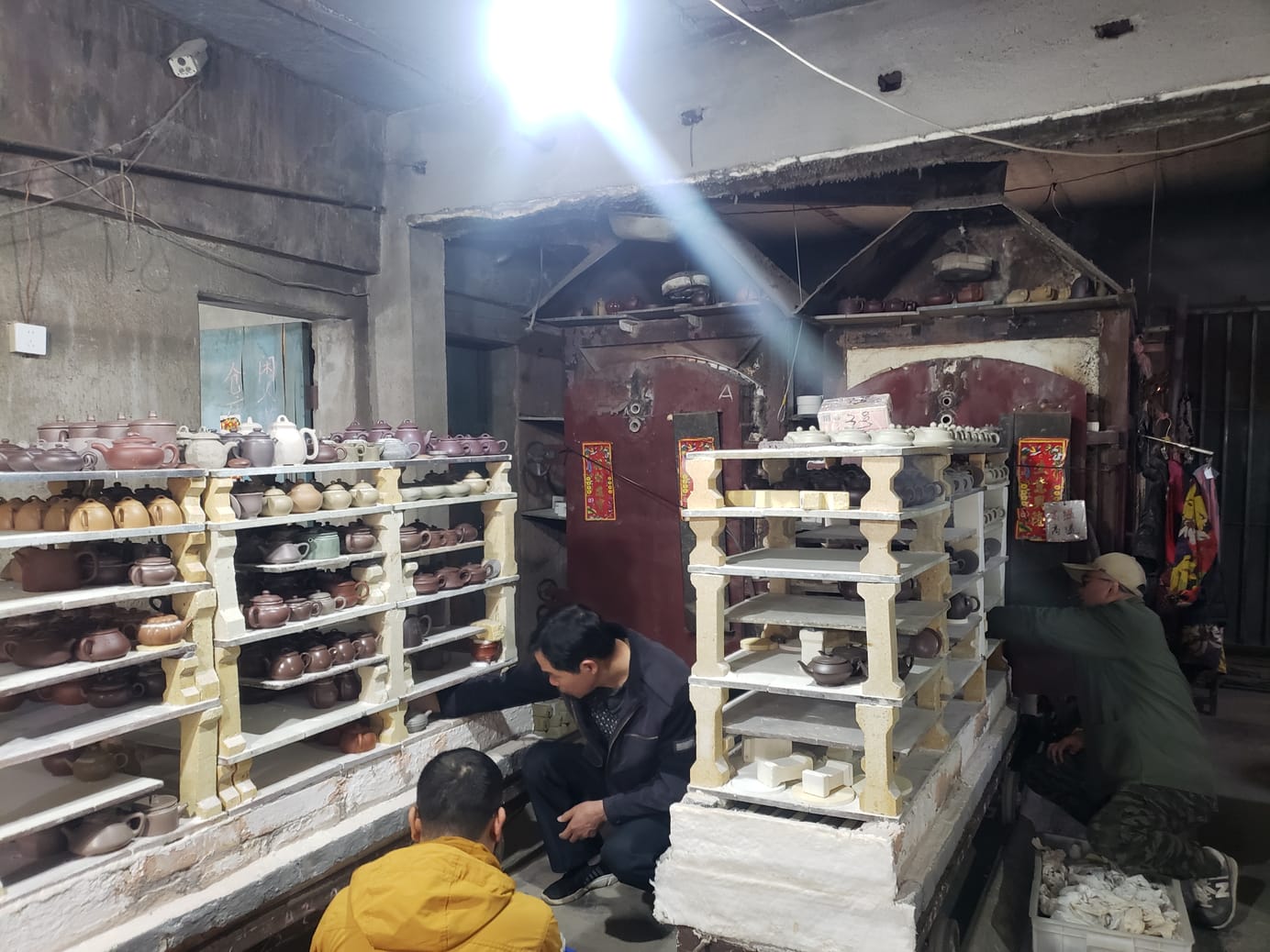
[00:02:25] Jason Cohen: And so what, what I think we're getting at here, so two, two sides to this. One is what, what the shuttle kiln is, right? The shuttle kiln. The shuttle is a giant rail car, literally rails that slides fully into the kiln. Kiln closes and it burns with natural gas.
But on the other side, I think that this is very interesting, right? We're talking about this reversion to a batch process. And independent artists for the first time firing their own wares. They don't have enough thorough put. They don't have enough money. They don't have enough resources in order to run tunnel kilns. And so now we suddenly see shuttle kiln. So what was the state of the industry then? 1990, are teapots expensive? Could we have been out there buying 10 cent Yixings? What was going on in 1990 in the industry?
[00:03:09] Pat Penny: You have quite a deluge of lower quality teapots that have hit the market between the, the late eighties, the early nineties. You do start to have privatization where you do have some famous collectors who are starting to request private batches of product, which, now with the hindsight of history, we know that maybe those would be a few that we would want to get our hands on. But otherwise, by and large, there's not a lot of 1990s Yixings that people are seeking.
So we know that there was quite a lot of mass produced product that really, I think as like practitioners we're not particularly interested in. So I think this is an interesting pivot where you do start to see probably artisans who were looking to fire something that might have matched previous historical processes that they had heard about or they want start testing and experimenting potentially to develop more interesting or better teapot designs than what they had been trained with for the past few decades. Maybe those who were disinterested in what they had seen in the mass market. I'm sure those would be in the minority though.
[00:04:12] Zongjun Li: Yeah. 1990s marks the starting point, the real starting point of the open up policy and the closure of F1 alongside with a lot of these collectivization factories led to the situation that a lot of these workers getting laid off. So they don't have a job. So, what they end up doing is starting a bunch of these little studios, private family owned run businesses and they don't necessarily have the resources to maintain a larger production anymore. So this is really the situation they end up having, like, they have to continue do the job that they're good at. And shuttle kiln is a perfect substitution of large scale tunnel kiln.
[00:04:56] Jason Cohen: And yet it is, it is a transient technology, right? Or it's maybe it's not very much a transient technology. We saw shuttle kiln still in use today in Yixing. We were at a shuttle kiln during the 2023 research trip.
Are they considered to be superior? Are they inferior? Particularly, are they inferior versus tunnel kilns? What, what do we think of wares that have been fired in a shuttle kiln?
[00:05:18] Pat Penny: Artisans that we had met with and worked with fire in both. So, I, I don't really think I got the sense during that trip that one was better than another. I think there was maybe certain purposes for that artisan, that one kiln might be preferred over another, depending on either the material he was working with or maybe even time or cost constraints.
[00:05:39] Zongjun Li: Yeah. And it seems like the shuttle kiln has a, a slightly larger temperature range than tunnel kiln because of the nature of the two variants of temperature range from both carts. You, you tend to have a large liberty of adjust the temperature for your wares.
And also very interestingly, I, I think that modern days tunnel kiln in Yixing also adopt the mechanism or the business model of shuttle kiln. Like we see a lot of these smaller studios still use tunnel kilns too. And they, they basically go through a similar payment system that they pay a subscription or a single use fee. And then they just have their wares getting laid in these large bat which will get pushed into the tunnel kiln.
[00:06:28] Jason Cohen: Yeah. My, my take was that the higher temperature wares like zhuni that couldn't be fired in a tunnel kiln get fired in a shuttle kiln.
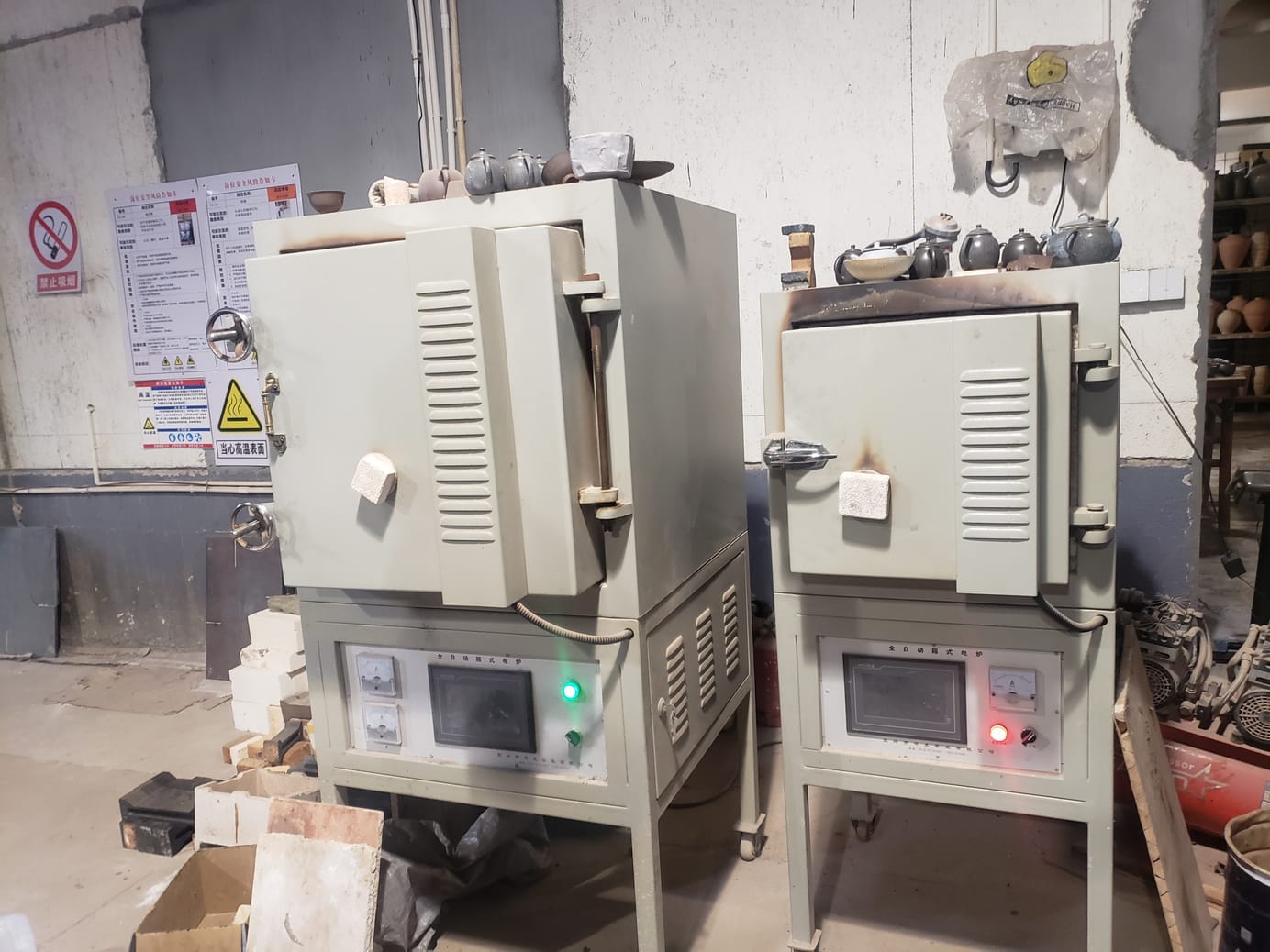
[00:06:35] Pat Penny: The shuttle kiln that we saw for some reason, my memory, I thought it was electric, but did we see a gas one?
[00:06:41] Jason Cohen: No, I think that that was a gas shuttle kiln. Or it was retrofit. I was trying to look through that in the notes, but I believe that the photos that, that we have are gas. But I
[00:06:52] Zongjun Li: I think it's gas because if not, then there won't be really a temperature range. Right? Like from top to bottom.
[00:07:00] Jason Cohen: Yeah. 'cause the heating coils usually span across the sides of the kiln.
[00:07:05] Zongjun Li: Yeah.
[00:07:06] Jason Cohen: Are there any telltale signs that indicate a ware was fired in a shuttle kiln?
[00:07:13] Pat Penny: I think it's easier to know if a ware was not fired in a shuttle kiln versus fired in a shuttle kiln. With basically the shielded heating element, you can be pretty sure if you see has anything that might have been touched by ash, right? Or have any kind of kiln transformation, I can be pretty sure it wasn't fired in a shuttle kiln.
[00:07:30] Jason Cohen: I'm not sure if I could tell if a, a ware it was fired in a shuttle kiln. I think maybe because it doesn't have a saggar if the temperature fluctuations a little bit faster so that maybe the texture is a tiny bit more matte. But I think it's extra hard 'cause I think that a lot of the shuttle kiln wares are still double fired. So they still are either pre-fire electric and then fired in the shuttle, or they're double fired in the shuttle kiln after a zhengkou. So I, I think it's really hard to tell.
[00:07:58] Zongjun Li: Agree.
[00:08:02] Jason Cohen: Given that it's so hard to tell Zongjun, do you desire or avoid wares from a shuttle kiln?
[00:08:09] Zongjun Li: I don't think you could desire or avoid anything coming from a shuttle kiln. First it's so hard to tell. Second, it's so uncharacteristic that it's really hard to form a preference or dis preference towards it. It's a very neutral method of getting your wares finished, so to speak.
[00:08:29] Pat Penny: I think it's one of those things where once we were there in Yixing and experiencing the different environments for these kilns, I, I could appreciate at least what was going on around them. But you know, until I try side by side, a tunnel kiln versus a shuttle kiln, I don't think I can even form an opinion. And I have a feeling that after I try them, I probably still won't have much of an opinion.
[00:08:56] Jason Cohen: No, I think, I think, if anything I would, my assumptions are that with the double firing and now with all the mixed firing between the electric and the shuttle kilns, I, I, I can't imagine that there's anything super specific that there's any super telltale attribute.
[00:09:13] Pat Penny: I mean, if you're, if you're not working directly with an artisan and able to request a specific firing, you're never gonna know anyway as far as like what's available on the market at large, there's gonna be no way to tell that it's shuttle kiln versus any other kiln.
[00:09:28] Jason Cohen: Yeah. Although, I guess, I guess we should say for contemporary wuhui, we shouldn't be so sure that there's absolutely no yaobian or kiln effects because you could put a saggar filled with hay or other combustibles into the shuttle kiln that would likely, I do believe that there's a shuttle kiln fired wuhui which because of the presence of the ash inside the saggar can leave some kiln effects of just,
[00:09:54] Pat Penny: Yeah.
[00:09:54] Jason Cohen: Occurred to me that we should clarify that.
[00:09:56] Pat Penny: That's a good point. That's a good point. So I guess, without the addition of anything, it normally is a clean burning kiln and wouldn't have any kind of kiln effects, but certainly artisans can artistically choose to, to do that by adding material that's combustible.
[00:10:11] Zongjun Li: Yeah.
[00:10:11] Jason Cohen: I guess that's another difference with a tunnel kiln, right? You absolutely cannot do yaobian in a tunnel kiln. The rate of firing is too fast and you won't get the full desired effect. So shuttle kiln, you can of course time the firing and you can keep it going for as long or as short as you want, and you can even time the time temperature curves which they do. I guess that's, that's an interesting difference. It was almost strange in a way, being there at this shuttle kiln, which is a type of kiln type that we haven't really heard much about. We didn't read much about in advance going. We, okay, here we are at another kiln. We had just been at the tunnel kiln, which is gigantic and, and an important component. And people talk about it a lot. And we get to the shuttle kiln, much, much smaller, orders of magnitude smaller and there wasn't a lot going on. It's two gigantic stacks.
[00:11:00] Pat Penny: I didn't even know what we were doing there. It took a few seconds for me to realize there was two kilns there.
[00:11:07] Jason Cohen: Yeah. 'Cause it's not blazing hot. You're not getting a sweat bath. The kilns turn on and off. It's fully batch processed. You show up, drop your wares on a rack. You, you arrange it as you want. You pay the guy, you walk and he tells you when to come back. And that, that's it. You're not, you're not really babysitting anything.
[00:11:25] Zongjun Li: Yeah, very small business.
[00:11:28] Pat Penny: Yeah. It didn't quite have the entire community around it that the tunnel kiln did too which understandably, because so many wares are going through that tunnel kiln ecosystem as we could call it. Whereas this was really, I feel like we entered a few couple like doors. We went under a few overhanging roofs, and then here we were in this small kiln area with like, I don't know, maybe four other people were there.
[00:11:50] Zongjun Li: Yeah. So really your neighborhood Uncle Joe's kiln, like, it's probably just for the community living nearby.
[00:11:58] Jason Cohen: Yeah. Yeah. It's interesting to think about because I wonder if we do or would find a difference if we took the same wares and had them fired in a tunnel kiln versus a shuttle kiln versus an electric kiln. All three of the modern kilns. But then on the other hand, I get the idea that the same wares really aren't fired that way. Right? That, that our primary contact, who we do the most work with, he tends to only fire the zhuni and much higher fired ware, some of the luni wares in the shuttle kiln and everything else goes through the tunnel kiln. I guess the cost per piece is much lower in a, in the tunnel kiln.
[00:12:37] Pat Penny: Yeah, I'm, I'm sure economic factors play a, a larger part in it than we realize, as outside users of the ware versus crafters of the ware.
[00:12:46] Jason Cohen: I guess my last question, given all of this, are there any advantages to the shuttle kiln? We talked about it being slightly more expensive, marginally more expensive per piece than the tunnel kiln, we talked about that it's, it's a bit lacking in any distinction. So if, if this is the case, other than it gets hotter, which some other films can do, right? You can go back to potentially one of the few wood fired kilns. You could go to an electric kiln. Why are artisans using a shuttle kiln? Why were shuttle kilns brought to Yixing? Why are they used? Why are they still used?
[00:13:18] Zongjun Li: My suspicion is that this is really a, a good way to do experiment, to experiment how your clay and your wares perform in different temperature in a more economic way. 'Cause like electric kiln, it's electric, right? Like the wares aren't really necessarily touching any flame by the end of the day. And for shuttle kilns, it is a burning environment and you have a relatively larger temperature range. And it's pretty efficient for you to discover what's the most optimal temperature for the specific type of clay that you end up having for making it wares. And once you find out that temperature range, maybe you can batch fire them in a tunnel kiln in the future. But I think this is a good method to discover that range in, in a relatively quicker way.
[00:14:08] Pat Penny: Yeah, I think you can tell all of our background in like food and like CPG 'cause we're all like, oh, it's kinda like a pilot system.
[00:14:15] Zongjun Li: Yeah!
[00:14:15] Pat Penny: Because truly, if you're gonna do a hundred teapots in a tunnel kiln, you wanna make sure that you know the correct placement in the kiln based on temperature and time. And much better to find that out with five pots in a shuttle kiln than to try on your first run with a hundred in a tunnel kiln.
[00:14:32] Jason Cohen: I think that that's right. I, I also think that the idea that, you know, this versus an electric kiln, the electric kilns are generally slightly reductive. They seal pretty tight. And the shuttle kilns are still slightly oxidizing, which is generally better fit with the burning fuel and for interaction with the clay.
I think one of the other reasons is, is because of the flexibility which we were, we were sort of getting at with the ranges of temperatures and everything. But not just that, but the, the shuttle itself is super flexible. It's just a rail car and you can put giant pieces on it. You can put small pieces on it, you can arrange a shuttle to, to fire irregularly sized, regularly shaped things that couldn't fit, wouldn't fit into a tunnel kiln or that would have too much of a temperature gradient across the tunnel kiln. So I think, I think some of that early flexibility, 'cause we should, we should also remember, 1990s when these things were adopted, the, yes, Yixing was still firing teapots. Some of the teapots were less, less stellar than what we, as practitioners are interested in. But a non negligible portion of the business is shipping bonsai pots to Japan and flower pots around, around the world. And so an irregularly sized variable sized flower pots that you could fire quite easily, I think is also a driver of the shuttle kilns.
Well, everyone, that's all the time that we have for today. Not really. We actually have a lot more time scheduled out, it's a two page, two page chapter. We are, we are through, we are through questions before time runs out. So,
[00:16:08] Zongjun Li: We wished we can talk more about shuttle kilns, but it's, it's really simple.
[00:16:15] Jason Cohen: There's not much more to say or ask.
[00:16:17] Pat Penny: If you saw the chapter, you'd be surprised that we were able to talk this much about it.
[00:16:21] Jason Cohen: Yeah. Well after, after the 30 page chapter and the 20 page chapter back to back, this was a refreshing...
Well everyone, thank you again for joining us in this edition of Tea Technique Editorial Conversations. Please join us again for our next conversation on electric kilns.

)