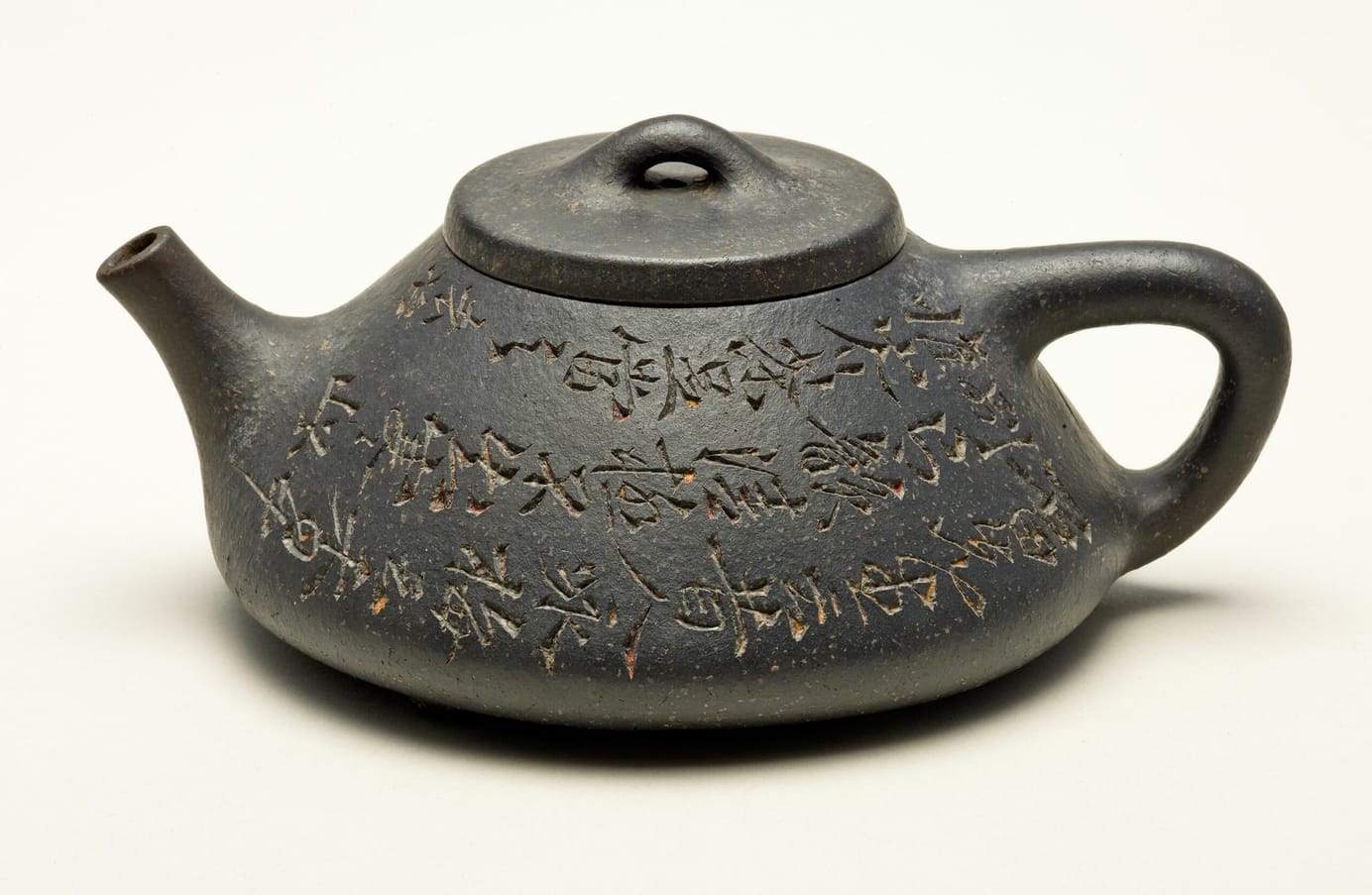
Editorial Conversations: Chapter 10, Section 8: Reduction Firing of Wuhui (焐灰)

The episode is also available on YouTube and Spotify.
A full transcript is included on the episode page and below:
[00:00:05] Jason Cohen: Hello everyone. I'm Jason Cohen, the author of an Introduction to the Art and Science of Chinese Tea Ceremony. Today we're discussing book two, chapter 10, section eight, Reduction Firing Wuhui Black Yixing. Here to talk about this chapter is our editorial team Zongjun Li.
[00:00:20] Zongjun Li: Hello, hello
[00:00:21] Jason Cohen: and Emily Huang.
[00:00:23] Emily Huang: Hi.
[00:00:25] Jason Cohen: Hello everyone.
For listeners, Pat might be able to join us quite soon, so if so, we'll catch him up. My first question, what is wuhui?
[00:00:35] Emily Huang: So, wuhui basically translates to smoldering ashes. And these type of Yixing pots tend to be black, dark gray, black-ish in color, and it's produced through a reduction firing process.
[00:00:51] Zongjun Li: And very interestingly there are a lot of different confusing names for wuhui. And one way you can spell wuhui as a different character, but it's also pronounced as wuhui which means covered ash. But the ash part remains the same which is a very important component of this process.
[00:01:10] Jason Cohen: So smoldering ash or covered ash are the two ways of characters both pronounced the same way. So wuhui is a reduction fired Yixing ware. Is that right?
[00:01:21] Zongjun Li: That's right.
[00:01:22] Jason Cohen: And this reduction firing renders the clay black. So can this process be done to any clay? Only specific clays? It is not itself a black firing clay?
[00:01:35] Zongjun Li: Yeah, any clay, as long as it contains any iron content which is a very important component for the black colorization.
[00:01:43] Jason Cohen: When were wuhui wares first made and when did they become desirous or popular?
[00:01:49] Zongjun Li: The exact invention date of wuhui is unknown. But people can find traces of wuhui wares date back to Ming Dynasty. But it was really getting popularized during Qing and early ROC mainly by this guy called Cheng Shouzhen (程寿珍) or (冰心道人) Bingxin Daoren. He is a, a major teapot maker himself and commissioner during the late Qing, early ROC period. And he himself is a, a person from the town of Yixing. So a very firsthand interaction with the production and publicization of this ware.
[00:02:23] Jason Cohen: What led to it becoming popular? So these things exist. They're actually accidental firings at first. They're actually considered a flaw at first. So was it he who popularized it, or what happened where people began to desire black colored Yixing?
[00:02:38] Emily Huang: Are you looking for a specific date 'cause I feel like there's no... we, we don't have a specific date. And it was just like a, kind of like a gradual, at first there wasn't a lot of it. And then as people start to find out what it is, they get more attracted on the black because it's so special and rare.
[00:03:00] Jason Cohen: Exactly. It goes from special and rare, so people learn how to, how to produce it regularly. And then what happens?
[00:03:07] Zongjun Li: Yeah. Then people start to producing it intentionally. Wuhui itself is a type of yaobian (窑变) initially, and people didn't know exactly what happened, why these words accidentally turned black. And then, later on they figured out the mechanism of how to create this effect intentionally. And that became a, a type of technique.
[00:03:27] Jason Cohen: How did the process of wuhui change as demand for these wares grew?
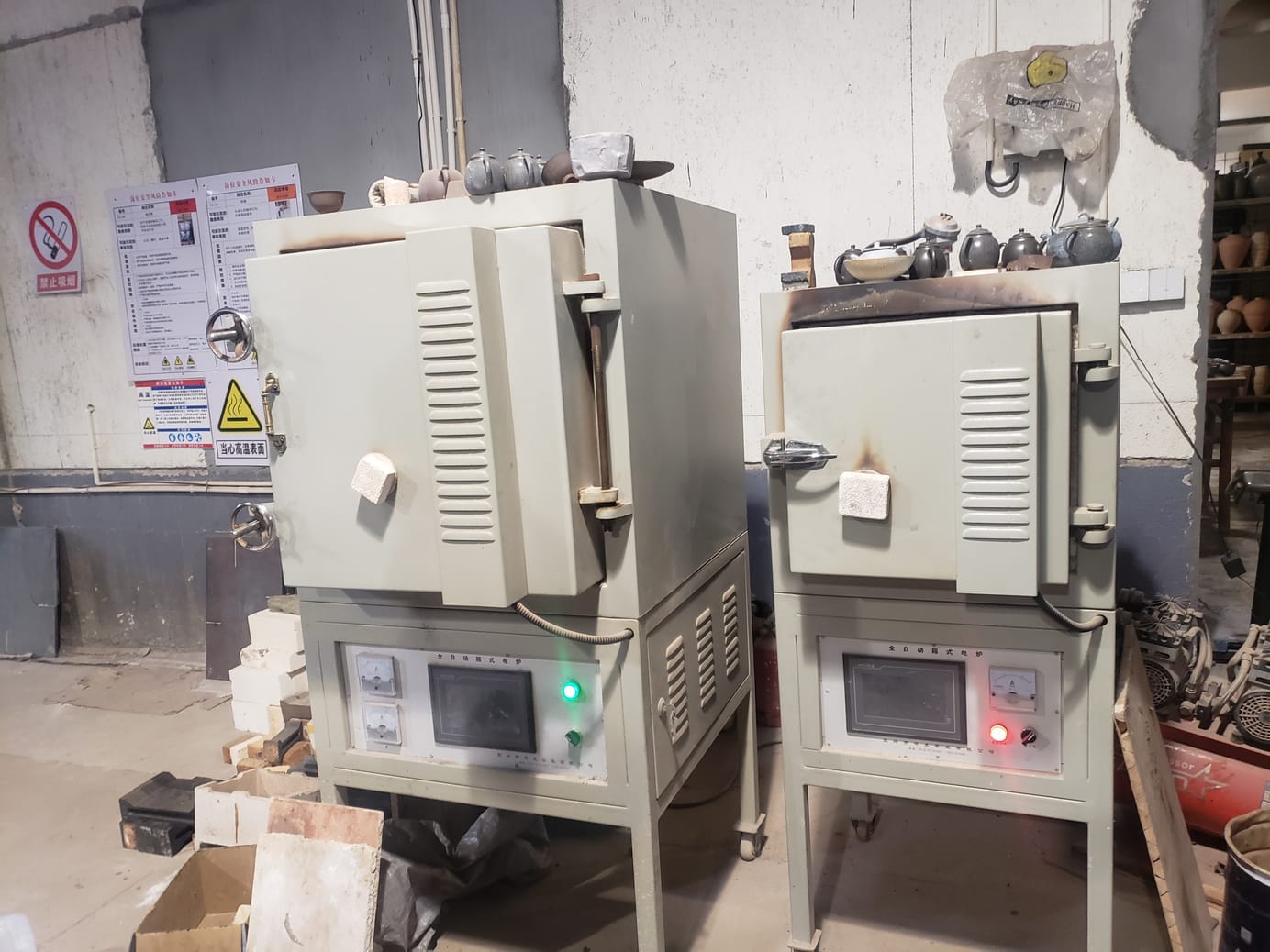
[00:03:32] Emily Huang: Yeah. So as Zongjun and Jason mentioned earlier, wuhui is a type of yaobian process. Wuhui became more popular as more people knew about it. So even though it wasn't very consistent at first, the artists were able to realize it's due to the ashes that were accumulated at the bottom of the kiln when firing and as time advances, they were able to find different ways to replicate that condition. So along with the introduction of electric kilns, for example, they were able to use electric kilns as a second or third firing for a more controlled temperature.
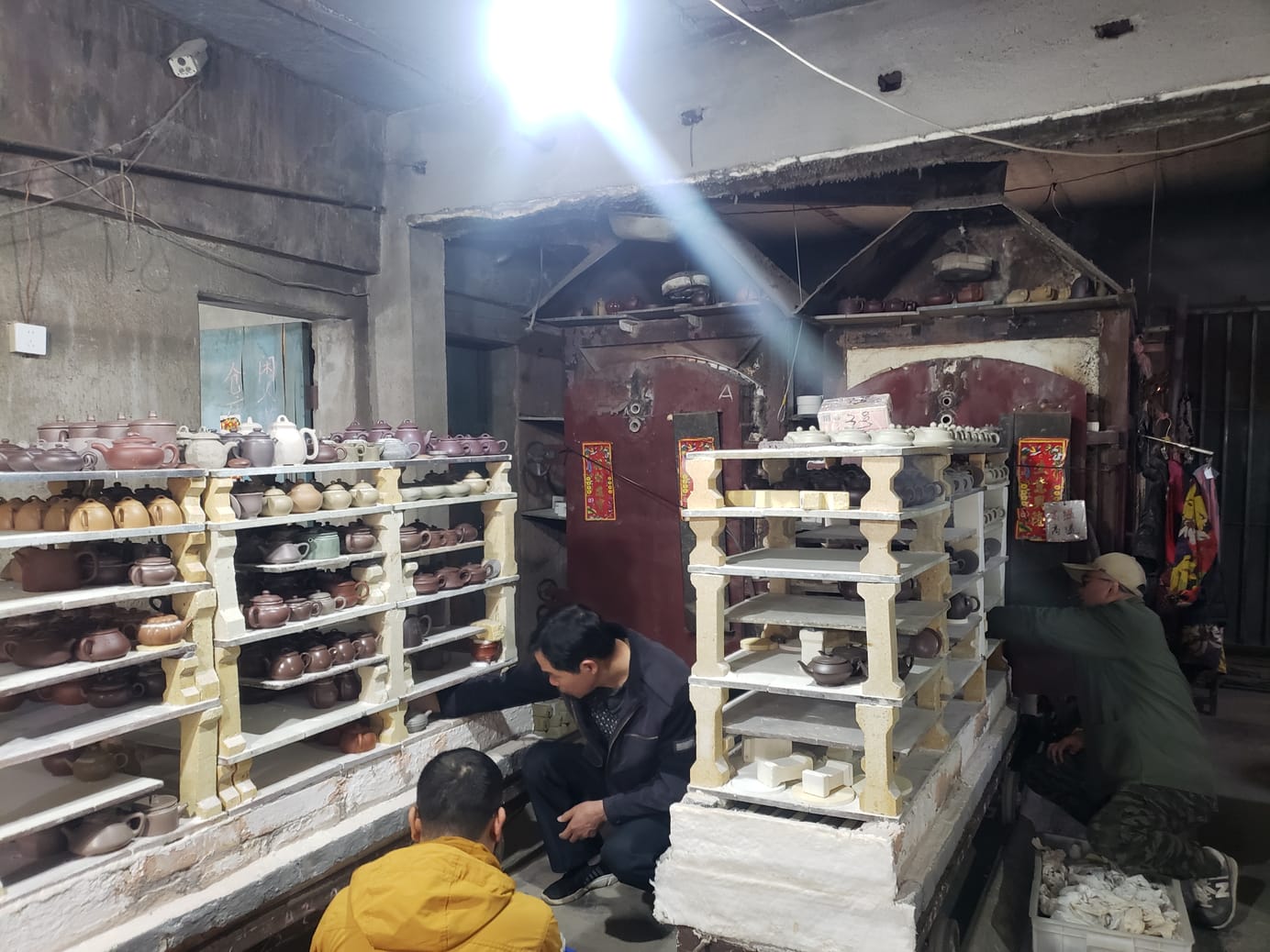
[00:04:19] Zongjun Li: Yeah, yeah. So, once demand grows, everybody can only think about how do we increase the quantity, right? So in, in the very beginning, all of these are happened very accidentally in the bottom of the dragon kiln where, as Emily said, all the ashes will accumulate over those regions and accidentally produce a very reductive atmosphere.
But, later on, as people figure out how to recreate that kind of condition, they put it in a pushbat, they put it in shuttle kiln, and they eventually did put it into a electric kiln. And the methods were largely pretty identical. Like you just stuffed the whole saggar with straws or rice husk and stuffed the teapot inside out. They figure out that if you didn't stuff the teapot inside, like there will be a color difference between the inside of the teapot and the outside. So, that's one thing that I found quite interesting.
And Jason and I were doing some research about how to create a reduction environment in electric kiln because it's not heated through combustion and apparently there is this new technology where they would create reduction of gas from a different chamber and blow that into the electric kiln to create a reductive environment. So without a husk and a rice straw inside the saggar, you can create wuhui with modern technology.
[00:05:39] Jason Cohen: I think that this is a great underexplored example of how a natural or perhaps incidental variation in a craft process can lead to the development of new techniques to make what was previously rare suddenly available. Because it became preferred. Because it was preferred, because it was rare and it was rare because it was an accident.
And so they figure out how to consistently create this and suddenly it becomes a trend. Wuhui was never a dominant trend. But did this additional availability cause wuhui to grow or fall in stature? What happened to, to price? What happened to demand? And were they more preferred when they were formed by accident? Or did their stature grow when they became suddenly available on the open market?
[00:06:23] Emily Huang: That's a really interesting question. So, from a supply and demand perspective, what started with a very special rare accident wuhui wares, with its increasing demand and then artists is starting to find out ways to replicate it, of course supply increase and therefore the price would go down.
Interestingly, what used to be so rare and special, only one out of a million, very special wares suddenly became not so special anymore because there were a lot of it in the market and more people from different backgrounds are buying it for different reasons.
[00:07:03] Zongjun Li: That's right. That's not cool anymore.
The price, of course, fell drastically. But now it's more accessible. So, actually the demand continues to grow and for regular tea drinkers, regular consumers, what once was such artistic rarity, now it's just readily available out in the market. So actually there were more people buying wuhui after the production method is cracked to render such effect on, on a teapot. So, that, that's quite interesting.
But, later on, this method got a little bit abused for some makers and merchants to use inferior quality clay or clay colorization to market what it's a made up term for heini or black clay. But it's indeed, either a lower quality clay or a clay mixed with a lot of manganese or other types of colorizer. So this is very sad, but you know, that's a reality that led to a mixed reputation of wuhui later on.
[00:08:07] Jason Cohen: Are all black colored zisha wares made from the wuhui process?
[00:08:11] Zongjun Li: Well, if it's pitch black, then most likely it's from wuhui. But you can use some very naturally dark clay and mix with some kind of a manganese colorizer to make it look more black. But you, you can still tell from the color that it's a little bit brownish, grayish, has more depth. But if it's like really, really black, that's usually happened through a reduction fired atmosphere.
[00:08:39] Jason Cohen: Or, or a very contemporary colorizer.
[00:08:42] Zongjun Li: Yeah, advanced modern technology.
[00:08:46] Jason Cohen: Modern, modern pot. You're talking about antique teapots. If the antique teapot is, is truly a deep black, that's wuhui. Otherwise, maybe a little manganese in ROC or sometimes kiln ash.
[00:08:59] Zongjun Li: Yeah, for those really modern wares, green tea and black tea, I don't know. Don't use them.
[00:09:05] Jason Cohen: Foul smelling shoe polish teapot.
We touched on this already, but we had said that an important component of the depth of coloration and the intensity of the black color of the wuhui ware is based on its iron content, but there are low iron content zisha material. So what happens if you take like a nearly no iron content luni (绿泥) and you fire that wuhui. Is that a good idea? Does anyone do that? What, what, what's the outcome?
[00:09:32] Emily Huang: The outcome would be, no one knows, oh, I guess we have to try it. Uh,
[00:09:38] Zongjun Li: A new commission idea.
[00:09:41] Emily Huang: Because of the reduction firing process, the color will definitely be darker. But as Jason mentioned the depth and the shade of dark black color really depends on the iron content. So, a lower iron content clay would give out a not as dark, not as black color.
[00:10:06] Zongjun Li: Well, my suspicion is that you are definitely going to see some color changes. It's not just iron getting oxidized or reduced through the chemical reaction. But without a large amount of iron content, certainly it's not going to turn into a very black color, probably into some kind of a grayish hue or grayish brown color. And also depending on the, the firing temperature too.
[00:10:32] Jason Cohen: Yeah, I think the luni stuff comes out of it sickly lookings. No one, no one really does it. Just kind of a, a pale gray of an, an imitation of wuhui black. So that, that said then, are certain clay types more or less common? We, we know obviously luni is very uncommon, but what about other clay types? Is, is one clay type most often done wuhui, or is it just other than the low iron clays, anything's done in equal proportion?
[00:11:00] Zongjun Li: I would say from my personal experience and after talking to artists in Yixing, mostly zini (紫泥). It's the most accessible, decent quality clay out there in the market. And the people tend not to use higher quality zhuni (朱泥) for wuhui because it's like putting very high quality tea leaf from Yiwu and turning into a shou puer. It's good, you can do it. But at what cost? You can sell it at a much higher price or on its own. So.
[00:11:34] Jason Cohen: Yeah. Lao Ban Zhang (老班章) shou.
[00:11:37] Zongjun Li: Wow, that hurts my ears just by hearing it.
[00:11:40] Jason Cohen: Yeah, actually I think I've mentioned this before, so I have two responses to that. One is that I actually do have a modern zhuni wuhui.
[00:11:50] Zongjun Li: Oh no!
[00:11:51] Jason Cohen: And I have no idea why I bought this. I never want to brew tea in this. I don't know what I was thinking. I saw it pop up. I'm like, oh, I never heard of that before. I mentioned this on the AMA. This is like one of the teapots that I kind of regret buying, even though there's nothing wrong with it. It's wuhui zhuni, it's high end zhuni. But yeah, I don't know what I was thinking there.
The other thing though ,actually thinking through, what, what's used most often. It's interesting that you said zini. I, I would've assumed hongni (红泥). In a, in a way, my assumption is that we don't really know, right? Like, going, going back particularly dragon kiln era, most of the clays were actually blends. Having pure single clays was relatively rare up through until late Qing, early ROC. And even in the ROC they were doing blends and you don't get pure singular process clays until the F1 and F1 didn't fire wuhui. So my assumption is we don't really know, and it's likely that it was some mix of zini hongni blends that were really getting, getting turned into wuhui in small amounts. But I'd be, I'd be open to debate on that. I don't, I don't think that anyone's ever undertaken a study of clay types of wuhui material before.
[00:12:59] Zongjun Li: I guess we are going to have to collect all of the antique wuhui and then do a reverse fire of those teapot.
[00:13:06] Jason Cohen: Figure out what they are.
What are the material effects of the wuhui process on zisha material? Specifically in the interaction with tea? What are, what are the material effects of wuhui and its interaction with tea?
[00:13:19] Emily Huang: It's found that the wuhui wares tend to give a more well-rounded effect on the flavor profile of tea. So that means muting of the base and more subtle mid notes. But accents the high notes and the sweetness of the tea.
[00:13:38] Zongjun Li: Yeah after some usage, I actually only find wuhui be good for shou puer or certain types of tea hongcha. I, I tried with some other tea types, didn't come out as well.
[00:13:53] Jason Cohen: That's modern wuhui that you're using and you're finding it's mostly for hongcha. Is that, Is that right, Zongjun?
[00:13:58] Zongjun Li: Yeah, that's right. I do not own any antique wuhui, but it's a contemporary wuhui fired with some aged zini.
[00:14:08] Jason Cohen: Yeah, that basically matches my experience. I've, I've had difficulty pairing wuhui with most tea types. I found some hongchas that it works with. But then I took some daye hongcha closer to a Feng Qing (凤庆) fermenty note than a, than a light beautiful (滇红) Dian Hong. And it just brought out all of the gaminess. It was the gameous expression of a yesheng daye (大叶) hongcha that I've had. It was a tea that I liked too. It was a terrible pairing. That I found pretty confusing.
[00:14:45] Zongjun Li: Funky.
[00:14:46] Jason Cohen: Yeah. 'Cause I usually think of it as a, as fairly muting and intensifying on sweetness. But I guess, if you're pulling out large molecules of sweetness in a tea that if the tea has a gamey base flavor, that you're gonna just extract all of that as well.
[00:15:03] Zongjun Li: You're missing all the mid notes. Wow. This is almost like a, like a chou sha method.
[00:15:08] Jason Cohen: Yeah. Chou sha for tea extraction.
That's interesting. I would, I would like to do, and we will do for, for this book, more experimentation on wuhui. One of our triplet sets, we have wuhui and we should probably do some more experimentation to be able to both quantify and qualify the teas that it pairs best with.
[00:15:32] Zongjun Li: Well, I would love to use it more. It's a, it is a cool looking ware, has a very metallic kind of texture. It gloss this really cool, radiant under light. It's a, it's a, it's a nice looking in fact. I just wish I can use it more.
[00:15:48] Jason Cohen: Yeah. Yeah. , Do you know, do you remember what red tea it's, it's done well with, 'cause it certainly hasn't done well with the, Feng Qings (凤庆) or the yesheng hongcha.
[00:15:59] Zongjun Li: I tried with some Taiwanese honey red tea. Those are mi xiang honey aroma red tea. Those are good. And, Dian Hong tastes pretty fine in my teapot, in my wuhui. And some of the decent quality shou puer but I've tried dancong, yancha and they all taste weird.
[00:16:20] Jason Cohen: Yeah. I've had good luck with my coastal Fujian red teas and Taiwanese red teas, stranded red teas. I have a high mountain summer harvest red tea right now. I should give that a try. I tried it with a bug bitten tea jassid red tea. That was quite good.
Last question. Why are wuhui wares coming back into vogue? Five or 10 years ago, we rarely saw contemporary wuhui and now they're commonly available, commonly produced by our preferred zisha artisans. What changed?
[00:16:57] Emily Huang: I feel like in a macro trend cycle way, it's like a opposing thing, right? You get very detailed. And you want lots of variations, lots of colors, and then too, oh, actually I want something more simpler. We can see this in a lot of the brand designs like fashion and all that. From lots of variations, lots of details. And then back to, Hey, I just want like simple, like the clay itself and appreciate the, the nature of what it is.
A couple years back, McDonald's introduced all of their packaging black. Did you guys know that?
[00:17:35] Zongjun Li: No, I did not.
[00:17:36] Emily Huang: Back in the days where everyone was looking for unique color cars, from bright red to green or blue. And then recently everyone's going back to like black or midnight black or something that's simpler. That's, that's more
[00:17:53] Zongjun Li: Just white or silver,
[00:17:55] Emily Huang: low contact, low profile, but high classy look. And to me, wuhui is just like that. It's classy.
[00:18:02] Jason Cohen: Feel like we're having a Mad Men era conversation. We need something that's simple, refined, timeless. We'll do it in black.
[00:18:11] Zongjun Li: I think I will agree with Emily on that one. It's not just about the color, it's also the teapot design too. Back in the days you see all of these crazy shaped teapot actually built for cha ren. For people who are drinking tea. And nowadays people like not only don't use those very colorful regularly. But also, people prefer their tea wares to look more natural in colored, less of a chousha, tiaosha or color speckle design. And to, to be their regular usage for tea drinking. So, that's quite a macro trend that's happening in general, I think.
What do you think Jason? Will you buy more wuhui tea pot in the future?
[00:18:51] Jason Cohen: Maybe for collection purposes, but I have one antique. I actually have too many wuhui teapots. Why do I have so many wuhui teapots? I have one zhusha (朱沙), one zhuni, one antique, one different mine zhuni, one Zhaozhuang zhuni (赵庄朱泥) and one zini. I don't know why I have so many and I never want to use them, so probably not.
So, for the book, I think I'm going to keep these around and I'm gonna use them and we're gonna profile them and everything, but these might be on the deaccession list as much as, as that pains me. But a couple of them, a couple of them are really nice. Of course, I have one of our design octagonal commissioned wares done in wuhui and my antique one has the most interesting textures. It's this, this incredibly dense, rubbery note. And it's actually a duanni (缎泥) antique wuhui from a high iron duanni that would've had the red speckles in it. Like a zhima duanni almost. But a little smaller than that and more even.
But to, to try to answer my own question, I don't think we know fully. I don't think there's any one reason why wuhui wares are back in vogue. I, I think that this is just part of the pendulum swinging that the, the technology was there. We knew how to make them. Merchants and zisha artisans were legitimately looking for differentiation and new things that they could do and looking back towards tradition, which is something that we as practitioners like it when they do. Whether that's fanggu (仿古) or, or bringing back older techniques and they found that they could run this older technique identically with contemporary technology. And so they started to make it and people said oh, look, black Yixing, real black Yixing, not, not dosed and, and colorized, not using modern techniques, but using traditional techniques and began to, to collect them and, and desire them.
And so we actually fell exactly into the same pattern as, as the literati of old. We saw something new. We saw something that was higher status. We saw something that our friends didn't have. We started to buy them. Everyone else wanted them. Producers started to make more of them. And, and now we think, oh, wuhui, that's everywhere, we can have it in whatever clay we want. Any contemporary maker has their wuhui. And I, I think that that just goes to show how much consistency there is in human nature. How much that this art form remains guided by these types of traditional buying cycles. We are the literati of today, and I think that the confluence of those things is, is such an interesting insight to, to, how much and how little has changed. And so we're on this side of the pendulum and in five years from now we'll be saying, wuhui. Well, who buys wuhui anymore?
[00:21:35] Zongjun Li: It was once a cool thing to own. And that was a very high starting point.
[00:21:40] Jason Cohen: Yeah.
[00:21:40] Zongjun Li: And then as you say that we have several vacuums in its development that wuhui is not cool anymore and then now it's coming back. That's a retro cool. So.
[00:21:50] Jason Cohen: Thank you everyone for joining us in this edition of Tea Technique Editorial Conversations.
Please join us again for our next conversation Flaws in Zisha Clay.

)