Editorial Conversation: Chapter 11, Section 2: Under-fired Zisha Clay

The episode is also available on YouTube and Spotify.
A full transcript is included on the episode page and below:
[00:00:05] Jason Cohen: Hello everyone. I'm Jason Cohen, the author of an Introduction to the Art and Science of Chinese Tea Ceremony. Today we're discussing book two, chapter 11, Flaws in Zisha Clay, Under Fired Zisha Clay. Here to talk about this chapter is our editorial team, Patrick Penny.
[00:00:20] Pat Penny: Hey, hey!
[00:00:21] Jason Cohen: and Zongjun Li.
[00:00:23] Zongjun Li: Hello, hello!
[00:00:24] Jason Cohen: Hello, everyone.
This chapter begins to reveal some of the long hinted research we've been doing on yixing and tea interaction. Could we say that experienced practitioners are divided on this topic? In my view, many of the experienced practitioners say that zisha material has no effect on the flavor of tea, that it's just inert ceramic. While others claim that different clays have specific effects. Will this chapter make both groups unhappy and prove to be controversial with everyone?
[00:00:55] Pat Penny: I'll start by answering yes. Yes. And probably more yes. So, you know, I think in the chapter you lay out a theory that I believe is very strongly researched. Definitely makes sense both from a chemical standpoint and mechanistic standpoint. But I think also answers a lot of the anecdotal experience we have when using teapots. But I do think that people have a strong bias that the way they believe it works is correct and it will be challenged by the theories that you have laid out here. And I'm sure that we're gonna get lots of hate mail for it and looking forward to it.
[00:01:28] Jason Cohen: Zongjun, does the same type of divide exist in the Chinese language tea community?
[00:01:33] Zongjun Li: I think in Chinese community is generally leaning more towards different clay types do have a impact on the flavor of tea. I think that's pretty much a general consent to some certain points, but the mechanism, the underlying rationale behind how exactly do these clay interact and impact of flavor of tea, I think it's remained as a a long time debate, and I think this chapter really highlights multiple aspect on how exactly these properties of different clays interact with tea and eventually making a impact on the flavor profile.
[00:02:10] Jason Cohen: Is there anything else that divides advanced practitioners within Yixing so much as tea clay interaction, or is this the topic? Are we touching the third rail of, of Yixing studies?
[00:02:23] Zongjun Li: I think for a lot of, at least within the Chinese speaking community, people tend to imbue certain theories coming from traditional Chinese medicine. So, they try to explain some phenomenon with, I would say to some extent, pseudoscience, but probably in most cases empirical science approach. Although certain phenomenon can be explained that way, it's probably not exactly that. But it doesn't necessarily dismiss that the clay is not making any impact or any influence on the tea. It certainly does, but maybe not in the explanation of some of the the theories out there.
[00:03:02] Pat Penny: I think this definitely is the topic, but I'm sure there's people who believe that there's other factors that are at play. And so we know there's people who think that the shape of a teapot might be the largest determining factor or the thickness. And there's certainly a group that believes that the development of patina is the biggest factor in affecting the flavor that you yield from a teapot. You've got those people who wanna just pour water into their teapot and think it's gonna taste like tea when it comes out. But I do believe that this is touching upon the most prescient point when it comes to what is a teapot doing for your tea?
[00:03:33] Jason Cohen: Are there merchant myths that feed this divide? It's almost comedic, right? That, that Yixings are prized and precious and sought after and collected and shaped the entire practice of tea. And yet we're sitting here in 2025 arguing about whether or not they have an effect. So how much of this is caused by the hyperreal and merchant myths, and how much of this is just a puer understanding or the level of understanding that's required in order to theorize about a causal mechanism for tea clay interaction.
[00:04:06] Pat Penny: I think it can be both, right? Like I, I think, just because there is an underlying rationale for something, you don't need to understand that to use it. And I think there's plenty of people who are happy to just buy teapots and use them because they're fun and they're pretty, and whether or not they do anything for their tea, I don't think those people care.
So, the mechanistic understanding is great for those of us who want to understand that. I do think that there's also tons of merchant myths that have been perpetuated because it would be pretty hard to sell more and more teapots to the same consumers if they want something different every time, right? Like, I don't think I would have the number of teapots I had if I didn't think that a zini and a zhuni were gonna have a slightly different effect with slightly different teas. I'm not as much of an aesthetic teapot user. And so for me I probably would own less teapots if I thought that there was gonna be no difference between any of the clays.
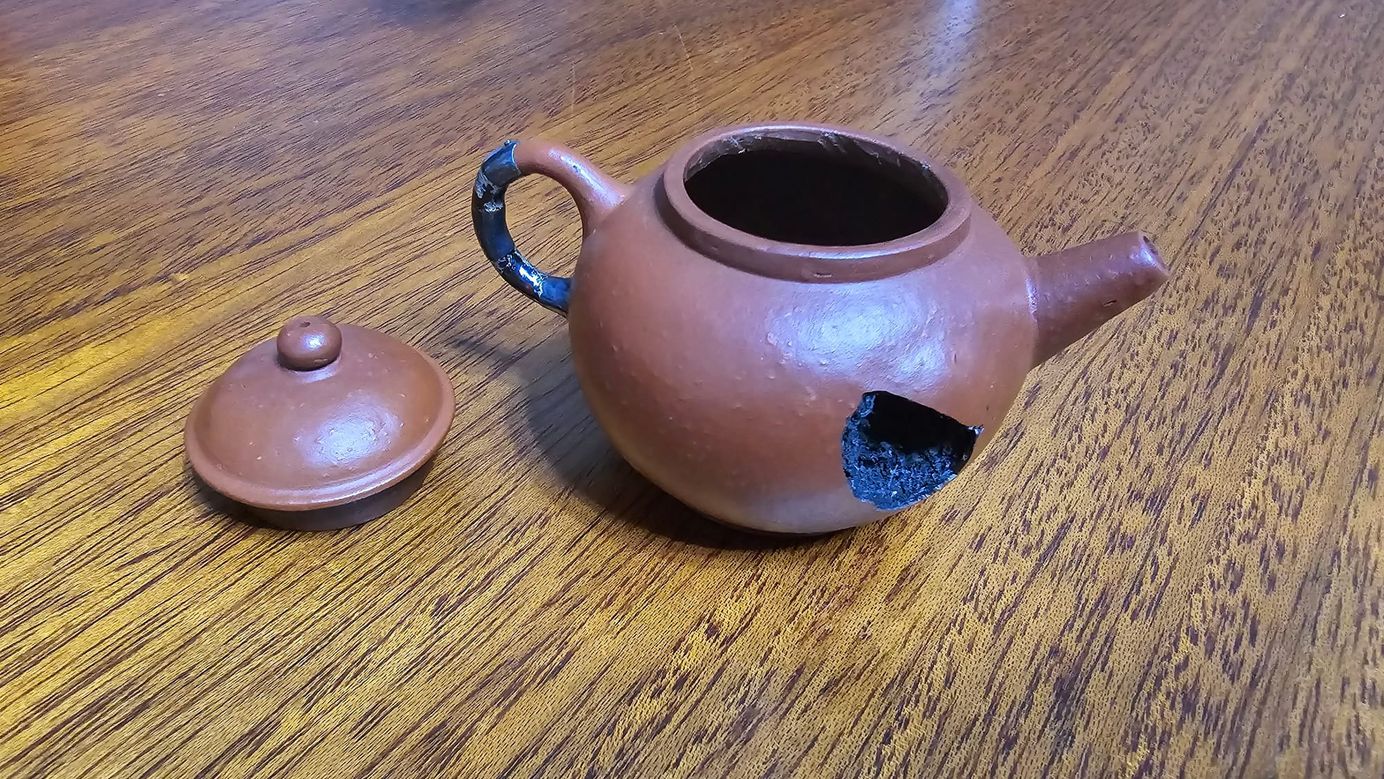
[00:04:55] Zongjun Li: And, to some extent or in some areas it might be just from total ignorance or a lack of knowledge from the merchant side or the community side. It's not necessarily a myth created intentionally. For example, people keep talking about how underfired zisha tend to generate tuhei (吐黑) and the theory within the Chinese community largely believes that it's because all of these micro channels that's forming within the teapot body because of under firing and making the teapot almost like a sponge. And, all of the organic matter is slowly leaking from inside to outside. We know it's not true, right? Like, it's really because of the coarser surface creating a larger adsorption that traps a lot of organic matters on the surface of the teapot. Both theory explains the phenomenon. Honestly, one way or another it doesn't necessarily do any harm. With research we are here really trying to figure out exactly what's going on.
[00:05:55] Pat Penny: Well, I think the myths can do harm to some people's wallets. Also, as people start to believe these myths and get deeper and deeper down the rabbit hole of tea, you also often have those people the most loudly perpetuating those myths or continuing to perpetuate those myths. And that becomes difficult when groups like us or other research groups go through and do careful research. And of course we're looking for people to test the theories we put forth and to interact with them. But you've got lots of loud voices that just perpetuate the myths that exist without really challenging the theories that we're trying to uncover or present. Right?
[00:06:31] Zongjun Li: That is true. That is true. Justifying flaws is one of the common intention of creating this.
[00:06:38] Jason Cohen: On that note, this is a chapter about flaws in Yixing clay, specifically under-fired Yixing clay. Can you define under-fired for our listeners?
[00:06:47] Zongjun Li: Well under fire is frequently, it doesn't necessarily mean it didn't reach the sintering temperature. Frequently it did. But it's usually not the temperature at the sintering range didn't maintain extended longer period of time leading a under maturation of the teapot. So the core or the inside of the clay didn't necessarily matured during firing. So, that's usually what under firing teapot end up having.
[00:07:17] Pat Penny: Yeah. So it doesn't mean that it's like a teapot that when you put it in water is gonna slack. Like it's certainly sintered, right? It's reached a sintering temperature.
[00:07:25] Zongjun Li: It could, but usually very severely under fired.
[00:07:30] Pat Penny: But, for just a quote unquote, under fired teapot, you don't have enough of the amorphous melt material. You haven't reached the densification of this clay that you're looking for. And so it is gonna much more strongly interact with the tea in a way that is often muting in a negative way.
[00:07:46] Jason Cohen: How can you tell if a Yixing teapot is under fired?
[00:07:51] Pat Penny: There's a couple different ways to approach it. And it really depends once again on the degree of under firing. But certainly if you have a reference piece, the density is going to be different. So an under-fired ware is gonna not have that same level of density and so forth size, it will feel lighter.
You also hear, I think, some differences in the pot as you're using it. So I think Jason, Zongjun, the three of us have definitely done like lid testing before where we're using the lid to get a sound from the teapot to hear if it's high pitch, medium toned or very low toned. And those lower pitches often can point towards a lower firing or potentially under firing.
And then definitely using the teapot, right? So if you taste tea out of the pot and you've got some kind of reference pot of the same material or porcelain as a reference, if you find that a tannic tea like a black tea or a really young sheng is suddenly like super smooth and tastes like water, this is doing a lot of muting and most likely is under fired if other attributes that I just described also line up with against the standard as mentioned.
[00:08:50] Zongjun Li: Yeah. One useful example or commission that our audience can try to do is to have a set of teapot fired in three different temperature. And if you have a reference piece that was fired in a correct way and then you can clearly see the difference between a under fired teapot and a correctly fired bot. Usually, the surface is coarser and the color is lighter. But that's also depending on different types of clay.
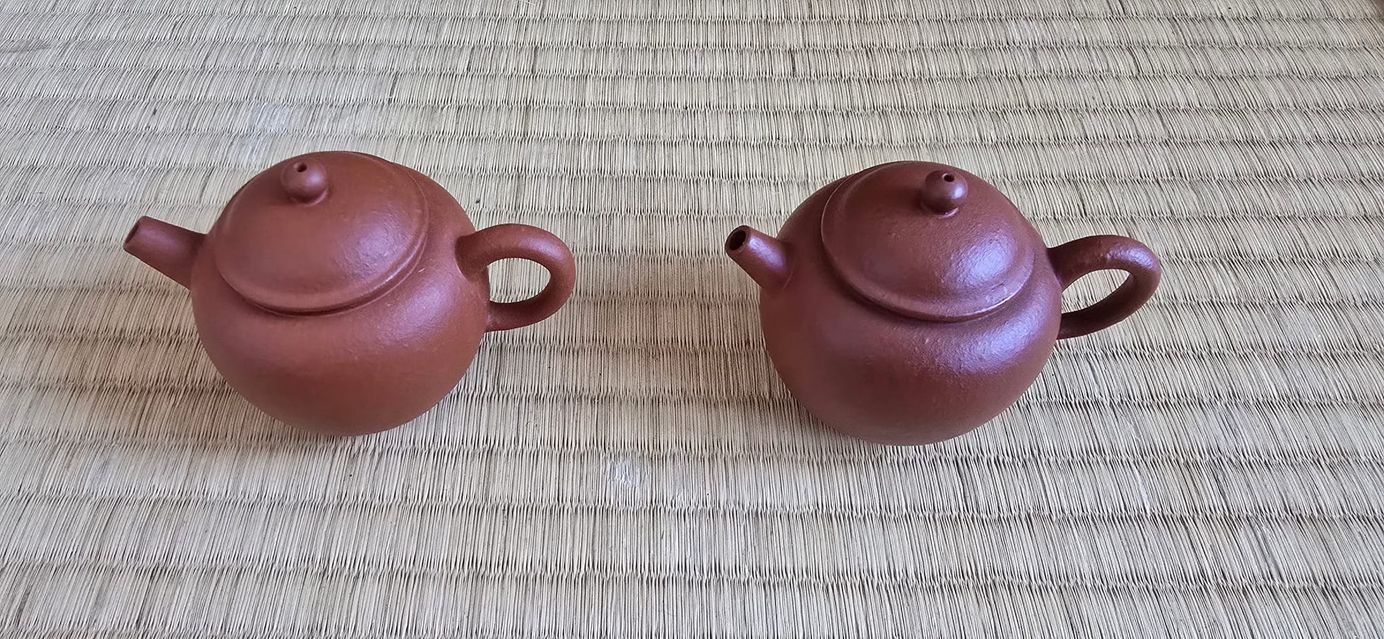
[00:09:16] Pat Penny: Zongjun just said, yeah, you can commission some teapots to figure out what's that like. Most people who don't have access to something like that, commissioning their own teapots. You can still find vendors who are trying to do this education. And so, Jason, the pair of teapots that you show in the chapter are not teapots that we commissioned. It's another western facing vendor. And so these were readily available online. I would just say you just have to keep your eye out for when vendors are offering this kind of educational teapot purchase.
[00:09:42] Jason Cohen: Pat, you had mentioned a flavor interaction for the under-fired teapots. Are you comfortable generalizing what that flavor interaction is and why many people call under fired Yixing teapots shou puer pots, shou pot?
[00:09:58] Pat Penny: Yeah, I think in the generalist of terms, the under-fired ware is gonna have a higher specific surface area. So you've got a very coarse surface that's able to have a lot of adsorption happening between the tea and the Yixing surface interface. And so a lot of larger, polymeric compounds, things like large polyphenol groups theaflavins, thearubigins and other compounds which do have a sensory or organoleptic effect. A lot of those are gonna be captured at that kind of interface and transformed and potentially the way that you're gonna then taste the tea would be much different. And in just a sensory standpoint often smoothed is the way we describe it compared to using a neutral surface like something like porcelain or glass.
[00:10:42] Zongjun Li: Yeah. It's almost like activated carbon.
[00:10:45] Jason Cohen: For under-fired Yixing wares, I usually say muting versus smoothing.
[00:10:51] Pat Penny: Yeah, I guess smoothing has a positive connotation in some ways. There's teapots that we purposely used because they might smooth out the roast or they might smooth out particularly aggressive bitterness in some teas.
But in this case, when we're talking about muting, it's really like you were looking for a degree of flavor or that flavor intensity is at a certain level. And if you utilize this pot or these pots that are under fired, a lot of the flavor and flavor intensity you normally look for in like a reference tea is gonna be gone.
[00:11:21] Zongjun Li: But for shou puer, you tend not to drink it usually in a connoisseur way. So,
[00:11:28] Pat Penny: Not even that, it's just that the flavor isn't always the most important thing, right?
[00:11:32] Zongjun Li: Yeah. You,
[00:11:33] Jason Cohen: I love my chenpi
[00:11:34] Zongjun Li: And sometimes, some puer can be a little dank. So some level of muting effect will certainly help the other puer to be more drinkable.
[00:11:44] Pat Penny: I mean, the Hello Kitty teapot is fine for the chenpi puer as well.
[00:11:48] Jason Cohen: Are there, I don't put chenpi into any Yixing's. I don't believe in patina, but I'm not putting chenpi into
[00:11:54] Pat Penny: But I'm not gonna risk it.
[00:11:56] Jason Cohen: into the Yixing. Are there any other examples where muting is a positive impact?
[00:12:02] Pat Penny: I mean, if you're a vendor trying to sell obviously flawed tea, I don't know.
[00:12:06] Jason Cohen: Well just, I've used under-fired Yixings for maybe two things. Actually, I don't really use them for shou puer. I just tend to drink shou puer laoren cha. But for very highly fired tea, very highly roasted tea, almost over roasted. Sometimes an under-fired teapot can reduce some of the more carbon-y char notes. And I find certain Jingmai puer, sheng puer to be incredibly tannic when young and using an under-fired teapot to reduce some of the tannic bite can sometimes be a nice experience.
[00:12:39] Zongjun Li: Young Bingdao or
[00:12:40] Pat Penny: Yeah, I think it's one of those scenarios where as you've learned more about the teas that you own and the pots that you own, you can start to make those right pairings and under-fired teapots can serve a function as the right pairing for certain teas. But I would say they often lack the functionality of many other teapots where they can be used with a broad range of teas to neutral or mostly positive impacts.
[00:13:04] Jason Cohen: I would agree. I would say that for the most part it is in the section of flaws because muting is generally undesirable.
So again, we're discussing the interaction and flavor differences for tea and clay. And yet this is a study of flaws. This chapter is on under-fired Yixing clay. So why focus so heavily on flaws and how can we use flaws to model the exceptions to the normal order of things?
[00:13:32] Pat Penny: This is a, a very philosophical question, but I'm gonna try and come at it with a pragmatic answer. So I think, until you know what is good, you're often most informed by what is bad to point you in the direction of what is good. You can have a range of teapots hitting a variety of different maturation levels. And, some will fall into the camp that we consider under fired. Some will be over fired. And until I think you've utilized a lot of pots, it's hard to learn what those characteristics look like and how they affect your tea. And so often, I think, when you're an earlier stage practitioner and you're starting to get into Yixing ware, you don't really have an understanding of how under firing or over firing impacts the tea that you're gonna brew. And so it, it takes quite a bit of time and education to really figure out why those things are flaws. I think having this chapter and showing what makes a teapot under fired and then how does it yield tea that maybe is less desirable or how might it impact the tea, that helps to show from there, what should the standard be? And so we know it, it's not in that under-fired range. And I have a feeling we're gonna talk about over fired in the future. And so this,
[00:14:42] Jason Cohen: There might be a chapter.
[00:14:44] Pat Penny: Okay. Yeah. I was thinking that might happen. And so, when you look at the edges we're able to figure out, what should the norm be?
[00:14:50] Zongjun Li: Yeah, I totally agree. And flaws are really not anything that's predefined. There's no such thing as a a predefined flaws. It's always a phenomenon that people after usage realizing that this is not correct, or this has negative impact on the usage of the teapot. So, until you experience the teapot with those characteristic with the teas. Then, you can make a judgment of if that's a flaw or not. Say for example, like, I bet you that looks like a flaw in the very beginning. But slowly maybe people afterwards figure out, it doesn't necessarily do a lot of harm to certainties and it actually looks nice, that people turn that into a aesthetic.
[00:15:36] Jason Cohen: So you're saying that the teleology of what is good is predicated on the preferences of the practitioner base?
[00:15:43] Zongjun Li: Yes.
[00:15:43] Pat Penny: As previously written in Book One.
[00:15:45] Zongjun Li: A very uh, Kantian approach to
[00:15:48] Jason Cohen: a study of beauty and aesthetics.
[00:15:52] Pat Penny: Please refer to Book One.
Well, there's nothing inherently or objectively wrong with an under-fired teapot. It's a teapot. You can put hot water in it, you can put tea in it. You can brew tea. It's not until you've developed preferences and an education that you, in comparison to what we consider to be the standard, realize that there's something wrong with it, which really is just a more complicated way of saying what Zongjun said so eloquently.
[00:16:19] Jason Cohen: Is this analyzable with the three levels of practice?
[00:16:22] Pat Penny: Until you get to the level of phenomenology, I think this material, an under-fired teapot to that practitioner is probably not known to be overtly a flaw. Once you get to the practicing level of phenomenology, the practitioner can put into effect this under-fired ware to yield the right brewed tea. Just like you were saying earlier, Jason, like using it with a highly fired tea or really tannic tea to get the outcome that they want. Prior to that, I think it's still a functional ware and so like your structural functionalist would probably approach this pot in the way much they would any of their other pots. And until they continue to learn they wouldn't understand the best way to utilize it for the desired outcome.
[00:17:03] Jason Cohen: Would you drive that down a level, Zongjun? Would you say that it has utility, but in its structural functionalist approach it could be notably different or negative in impact?
[00:17:14] Zongjun Li: Well, if we view this in a more deconstructive way, what is utility? To use it to brew tea or use it to learn? Both can have tremendous amount of utility for tea practitioners and for under firing teapot in particular, it's really a spectrum. The line between really like flawly under fired and still usable under fired teapots I think the line is very vague.
[00:17:40] Pat Penny: How have you been negatively impacted by catalytic oxidation of polyphenols and zisha clay tea pots?
[00:17:48] Jason Cohen: Only positive impact. My free radicals have been eliminated.
[00:17:53] Pat Penny: Has somebody you know been impacted by catalytic oxidation? Call now.
[00:18:00] Jason Cohen: We're receiving calls and live on the air.
[00:18:02] Pat Penny: California lemon laws can make sure that your Yixing teapot performs the way you want it to.
[00:18:08] Jason Cohen: Drive by Gong Fu.
How does the study of cleaning products relate to Yixing teapots?
[00:18:14] Pat Penny: It's a good question. So Jason did the readers deep service and honestly did Zongjun and I a deep disservice as we had to climb down all these references and read through all of the papers you cite. But you cited a paper in here where basically there is a ferric oxide or iron ion interaction that is being studied in one specific cleaner production paper. The reason they're doing it is actually to break down antibiotics in, in water, like wastewater systems. But you leverage the mechanism that was explored in that paper to better understand how potentially available iron ions in Yixing clay and teapots could be interacting with tea polyphenols, which is actually one of the compounds that they're specifically looking at in this cleaner production article. It was actually a really well written scientific paper. It was pretty quick to read through but did not expect that from the Journal of Cleaner Production.
[00:19:14] Jason Cohen: Tea polyphenol degradation in the Journal of Cleaner Production. That one was a trip.
[00:19:20] Pat Penny: Was that a Hail Mary when you were Google Scholar searching that? How did that come about?
[00:19:25] Jason Cohen: Not quite a Hail Mary. But there's relatively little proper chemical analysis on polyphenol degradation from non enzymatic browning sources. So this was one of the very few papers that showed up and was relevant.
[00:19:40] Pat Penny: What did your search history look like as you were trying to work this theory out?
[00:19:44] Jason Cohen: I search pretty frequently. More surprising I think than people would realize is how often I'm searching in Chinese. Google Scholars, of course, a great reference, but then the ability to go into the papers that the papers that immediately come up in a search site is often where a lot of the best knowledge and information lies. So finding a paper that's barely relevant, but cites information that might be relevant and following that citation trail. And sometimes that leads into dead ends. Luckily, very frequently, in the papers published in China, those frequently cite papers that are published in English in the United States. So my search history is quite erratic. The way to actually find these things, I find it to be very non-obvious and I think we've gotten better at it over time.
[00:20:30] Pat Penny: How do you leverage these citations and this citation inception, I'm gonna call it, going through layer and layer of citation to try and disprove anything that you are trying to theorize? So how do you challenge your own thoughts?
[00:20:43] Jason Cohen: Cytogenesis. It cites something that was never written in the paper that was cited. That certainly exists. That certainly happens more frequently than you would hope in peer reviewed academic publications.
Yeah, the worst feeling is following a trail of thought or an idea down the line only to realize that it is absolutely disproving something that you're hoping for. So, we've spoken before about textural effects and actually, most of this chapter started off as a study of surface texture interaction and surface textures of ceramics catalyzing oxidative or other types of reactions, nucleation point studies. And it turned out that there was very little of it and that the mechanism of the theory that we had started to develop and we were discussing was likely to be wrong.
And so over the course of weeks and months and years of doing this and pulling papers and having my own file structure for all of the research, I was able to see that actually it was unlikely to be the predominant effect, and that the interactions with polyphenols was much more complicated than I was aware of. Things like dimerization, things like the hollow holes in polyphenol chains capturing aromatic compounds. That, that was just not front of mind in my mental framework, thinking about solids and tea, or potential aromatics and tea sticking to the surface of a Yixing teapot and undergoing that sort of change.
So, I started that sentence by saying, this is some of the worst feelings, realizing that something that you had thought correct was going to be disproved. But it's a great feeling when it's replaced by something that you have evidence for which you don't always get so lucky on. And that, that was definitely a function of multiple weeks with this chapter.
[00:22:30] Pat Penny: So the editing team, we got about a week and change of editing this chapter which meant that after I read through it the first time, my first thought was like, what the hell. This is, this is nothing like what I thought was happening, when we're utilizing a Yixing teapot. And I went into like the five stages of denial where I was like, well, that can't be true. And then I start doing research, pointedly doing research to actively disprove the claims, that Jason's citations have yielded. And then eventually I get to some kind of stage of bargaining where like, well, that might be happening, but is there another mechanism that's really underlying all this? And fortunately for the readers and for Jason, we didn't come to any other conclusion but did find, I think, more papers which helped to prove that this mechanism laid out here is most likely the correct theory. But I think we're also looking forward to when this is published and our readers are able to comment on the chapter. I think we have a lot of astute readers and hoping to have them challenge this idea too with research of their own.
[00:23:28] Zongjun Li: One question. So I'm actually out of curiosity after reading this chapter is we talked about how the catalytic oxidation of polyphenols, they're driven by iron ions in the clay. And we also know that different zisha clay have different concentration and composition of these iron oxidates. So would that be a explanation from a chemical interaction standpoint, can be explained different impact of different clay to tea?
[00:24:00] Jason Cohen: Yes. This is a chapter on flawed Yixing, underfired Yixing. So the effects are going to be a bit more prevalent because of the increased adsorption. But as an overall ideal, the answer is yes. And in fact, there is different rates for this Lewis acid catalyzation sites between FE2O3 and FE3O4.
[00:24:22] Pat Penny: Yeah, and some of the papers that we looked at back and forth and that I had sent over Jason's way, some of them were just, I would call, so-so papers. They were not amazing. But they did look at different materials, including Zini, Zhuni. None of them got to a mechanistic level of why this was happening, but they did yield findings that showed that there was changes in polyphenol levels between these different materials. And so they did have a different impact.
[00:24:46] Zongjun Li: Interesting. Well, there's certainly a lot of factors going into the differences, right? Like, different clays are fired in different temperature, therefore they have different surface texture. And right now we also need to consider different iron oxidates content in these clays. So that's very interesting. We're adding another layer of complexity into this whole story.
[00:25:10] Pat Penny: And based on this theory then, what type of teapot would we imagine should have the largest impact on your tea? And Jason, that's because you believe it's got the largest free iron ion availability, or does it have more to do with adsorption ability?
[00:25:25] Jason Cohen: FE304 just coating the surface. An under-fired Wuhui would theoretically have the largest effect.
I mean, you do get into some strange effects where you start talking about things like totally vitrified Yixing which will be discussed in the next chapter. So not thinking through and also speaking off the cuff, a normal set of Yixing, a Yixing that would not be considered flawed, that would have the largest impact, would likely be Wuhui.
[00:25:56] Pat Penny: And I think anecdotally we've probably seen that, right? I don't think any of us have Wuhui pots that we think are optimal across all tea types. And that's because I feel like it has too large of an interaction with many teas. And then that might point to exactly what we're talking about.
[00:26:12] Jason Cohen: Increased sweetness and reduced fragrance is my standard assumption for what a Wuhui is gonna do.
[00:26:18] Zongjun Li: Yeah, they're usually good hongcha pots,
[00:26:22] Jason Cohen: We've been beating a little bit around the bush area. We should probably actually explain, layout the theory to listeners. Pat as the resident flavor chemist, do you want to explain what polyphenols contribute to tea?
[00:26:38] Pat Penny: Yeah, so from a layman's standpoint, most people have heard of polyphenols, if you're listening to this podcast probably because of tea. But you know, many people are familiar with wine or other polyphenols, like tannins. So polyphenols are these large compounds. They're often part of a plant's defense system. Basically, they're one of the first lines of defense against things like bugs or oxidative stress or sunlight stress.
And then as we consume these compounds in products like tea or wine or coffee, they usually have a pretty strong sensory impact and most of the time that is astringency. It might be astringency with a little bit of sweetness. There could be some body because these are quite large compounds and often color particularly when it comes to tea, but also wine when you think of tannins like anthocyanins. Specifically in tea, a lot of what we're talking about here is catechins or flavanols.
But, beyond color, flavor, all of that and the plant's own secondary metabolites or defense system, there's a lot of interaction actually happening with these catechins in the tea leaves as well. In the chapter we mentioned things like Theaflavins and Thearubigins, Theasinensin. And, all three of these, while they have some different color attributes and different contributions to body, for the most part, they generally attribute some kind of astringency to the flavor profile.
[00:27:56] Jason Cohen: And complex interactions with astringency, sometimes they can appear as mouth coating and dry or mouth coating and salvatory.
[00:28:06] Pat Penny: And I think, as you mentioned just earlier in this conversation, some of these polyphenols have different abilities to capture aromatic compounds as well, which I think is an important factor in this conversation.
[00:28:16] Jason Cohen: What is a Lewis acid catalyst site?
[00:28:19] Pat Penny: A catalyst is something that's able to basically facilitate a chemical reaction.
[00:28:24] Jason Cohen: Zongjun, we mentioned other physical attributes that affect the teapot's interaction with tea. What are some of those attributes in under-fired clay, beyond the Lewis acid sites.
[00:28:35] Zongjun Li: I think we have covered most of the negative impact of under fired teapot. The key flaw is a drastic increase of surface roughness which really increase the adsorption not absorption of organic compounds on the surface of the teapot. So, adsorption is not like absorption, which the organic matter doesn't necessarily be absorbed into the teapot, but rather than it remained on the surface of the teapot. So one of the extreme example of really severe adsorption is tuhei. So, all of the organic compound remain trapped on the surface and end up oxidizing and turning black.
[00:29:20] Jason Cohen: Pat, can you define absorption and explain how its confusion with absorption has misled a generation of scientifically inclined tea practitioners on this topic of Yixing teapots?
[00:29:31] Pat Penny: In my mind absorption is really like a molecule is basically being taken into a material. And adsorption is basically where a molecule is sticking to the surface of a material, but has not actually penetrated that material or it hasn't been absorbed into the bulk of that material.
So, this difference between adsorption and absorption really I think explains the difference between what Zongjun has mentioned in the past of the way that many tea practitioners in China believe Yixing teapots are working. And so, there's this thought that micro channels are able to absorb the tea liquid and the tea material. And then the teapot is soaking up, right? Absorbing this tea liquid that it can then give out. But adsorption is where there might be volatile or non-volatile compounds. In this chapter we discussed extensively polyphenols that are sticking to the surface of the Yixing material, depending on the surface roughness. They are able to have a pretty complex organic chemistry interactions with that material depending on what, in the case of Yixing, what maybe irons ions the materials interacting with. But in the case of other glazes, the different ion composition will change what chemistry is gonna occur. And then, that compound is changed, but it is not maintained in the material like the Yixing. When you pour out the tea those different complexes and different chemical compounds that have changed from the absorption are then gonna move into your tea cup.
[00:31:02] Jason Cohen: My penultimate question, why is the topic of tea and clay interaction so understudied? Is this just such a niche and nuanced theory predicated on knowledge of food chemistry, material science, physical chemistry, flavor chemistry, and possibly other topics like chemical kinetics that no one else came up with it? At 2025, why don't we just have a good scientific proof one way or another?
[00:31:24] Zongjun Li: On vendor's end, it's probably very conveniently understudied. Like a lot of these flaws, you don't necessarily want people to really understand the underlying mechanism of all that.
[00:31:36] Jason Cohen: Oh, but I do.
[00:31:37] Zongjun Li: Oh, you do?
[00:31:39] Pat Penny: Yes. Yes, Jason does.
[00:31:41] Zongjun Li: But after paying all these monies and buying all these teapots, you don't necessarily want to fund another research to eventually tell you that half of your collection is flawed. So, I think that's probably one of the reason why we don't quite see all of this information being widely talked about.
[00:32:01] Pat Penny: Yeah, I don't even think it has to do with flaws or it has to do with merchants so much as just, Jason, I think your question already points out, it's such a specific intersection of so many different disciplines. And just thinking about the way that most research organizations, specifically school-based research like universities are laid out. This is just such a intersectional study that the only place I can imagine this kind of work being done would be a university that is based around near Yixing, right? Like there is some of this research being done in China, which we were able to leverage to then come up with our mechanism. But nothing so specific that it was already out there that we could point to it. So I think research is being done on Yixing but maybe not by practitioners like ourselves and like other tea practitioners who are trying to understand this mechanism. And so the people who are asking the questions and have the resources to do these kind of tests to figure it out, they might not be practitioners who have the education to really hone the hypothesis that we're all looking to have answered.
[00:33:05] Jason Cohen: My last question, as the editorial team or as part of the team that, that's generating these theories, what does it mean for us now for what I think is likely the first time in this book that we are developing and promoting our own scientific theory versus validating or invalidating the theories of others? How do we know that we are publishing good science? We talked about our process of validation and reading the research, but what evidence in our own experiences do we have that this is correct, both within tea and potentially outside of tea.
[00:33:46] Pat Penny: Luckily we have plenty of anecdotal experience using Yixing teapots, and I think seeing results that speak to some of what we've seen from the mechanism and seeing how the inputs of the mechanism are transformed and create compounds that do line up with our understanding of what we've tasted. So, I think there's that.
On the other hand, as people who are trying to put out good scientific theory in the world, I would just say that I think we're very open to other people challenging that theory with well researched ideas of their own. And I think we would love, that's what good science is, right? We're putting a theory out there in the world. We would love for people to engage with it, try to disprove it, try to prove that it's almost right, but there's some slightly flawed idea in the mechanism. We want people to engage with it. And I think that's what good science really is.
So, we've done the research. It doesn't mean that it's correct. We, I think we have confidence in it. But we would like for people to engage with it and challenge us so that we can all, as a community, learn more. But I definitely don't think we're putting out something that's under research. I can say that for sure.
[00:34:50] Zongjun Li: Until we invest and commissioned our own centrifugal machine to test out the effect of particles. I wouldn't say, we can say for sure that we are certain that these theories are correct, but we have come to the conclusion with scientific research and it matches with our own experience. And if it does not with you or with your own research, please do share with us and we would love to have a discussion and figure all of these interesting topics out together.
[00:35:21] Pat Penny: I think that's where it's good science is that we are not trying to just have a soundbite and we're not trying to say that this is actually an immutable law of Yixing. All of us have studied science. My background is science. But Jason, you did quite a lot of food science when we were at university. We had a hypothesis. We have tested it. Until we have a lot more money, we won't be able to analytically test it the way we want, but we do plan to. But you know, we're putting a theory out there and hope that others will engage with it.
[00:35:49] Jason Cohen: We believe in the principles of peer review and we humbly submit this to the tea community to test and debate.
Well, everyone that's all the time that we have for today. Thank you for joining us in this edition of Tea Technique Editorial Conversations. Please join us again for our next conversation, yet more flaws in Yixing clay.