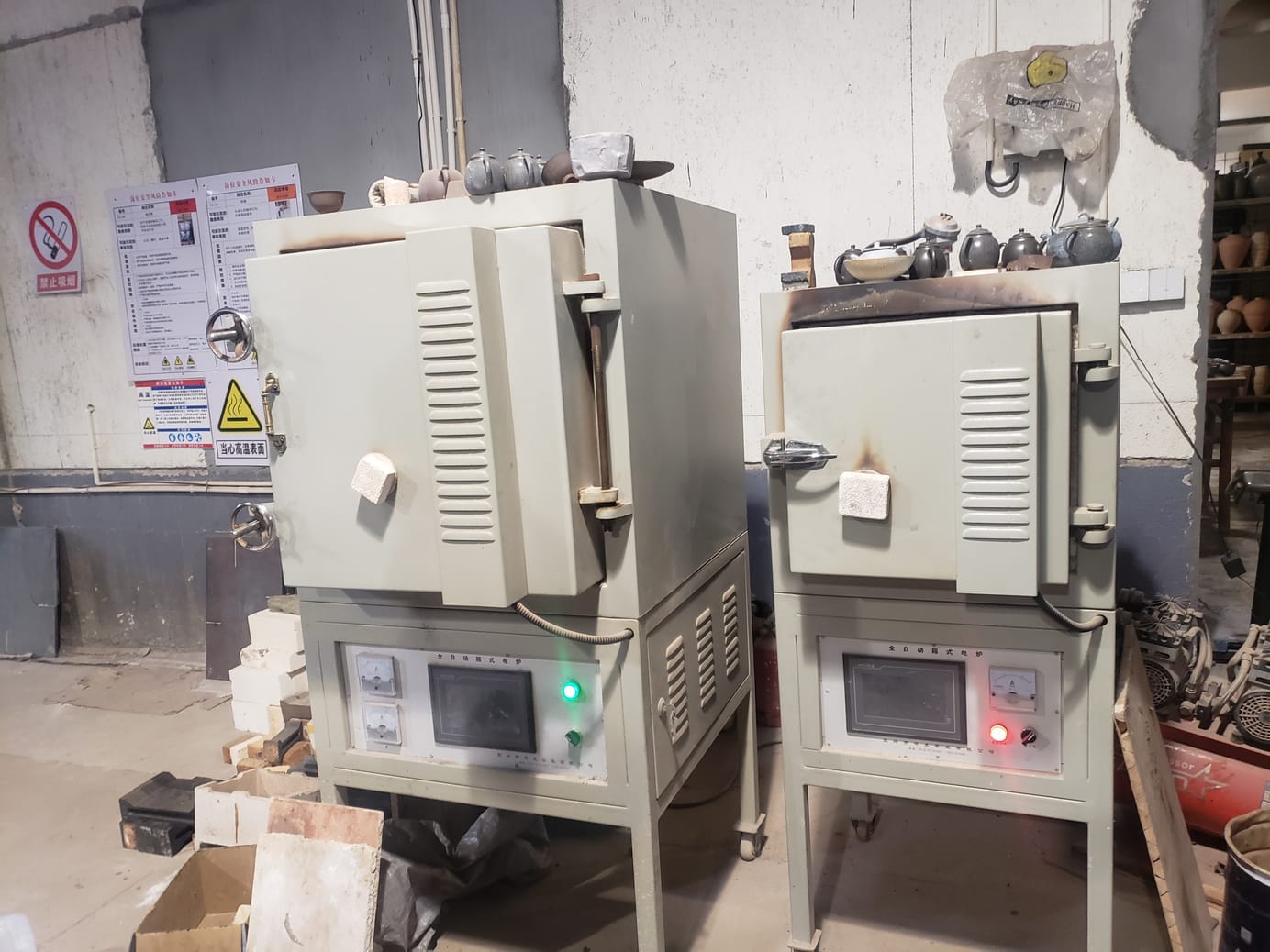
Editorial Conversation: Chapter 10, Section 7: Electric Kilns (电窑)

The episode is also available on YouTube and Spotify.
A full transcript is included on the episode page and below:
[00:00:05] Jason Cohen: Hello everyone. I'm Jason Cohen, the author of an Introduction to the Art and Science of Chinese Tea Ceremony. Today we're discussing book two, chapter 10, section six, Electric Kilns. Here to talk about this chapter is our editorial team, Patrick Penny.
[00:00:19] Pat Penny: Hey. Hey!
[00:00:19] Jason Cohen: Zongjun Li.
[00:00:21] Zongjun Li: Hello.
[00:00:22] Jason Cohen: And Emily Huang.
[00:00:24] Emily Huang: Hi,
[00:00:25] Jason Cohen: Full house. Hello everyone.
This is our last section on a specific kiln type, focusing on what is likely the end state of the technology ladder for firing Zisha clay. And it presents us with some, I hope, interesting questions about the use of technology, the value of tradition, and the economic versus artistic trade-offs within Yixing teapot production.
We've now gone from wood-burning dragon kilns, which lasted a, a few hundred years to tiny 20 teapot electric kilns in the span of about 40 years. Is the progression of kiln types, the largest single variable affecting the material properties of fired zisha wares?
[00:01:05] Pat Penny: I don't think it necessarily is, but it can be. So I think whether it's the type of kiln that's being fired in or the, the actual firing itself, so the temperature and time, the rate of firing, we know, and we've gone over in this book many of the reasons why firing is so important, but I do not think that the changes in kilns personally is the biggest variable that affects the material properties of this zisha clay.
From, the really early stages of this book, we talked about all the processing of the ore. I think we went into quite a lot of detail about how the processing plays a large, maybe outsized role in how the actual material is gonna interact with tea. But then from there, I would say, whether you fire an electric kiln or you fire in a pushbat kiln or dragon kiln, as long as you fire properly, while there will be material differences in the topology and pore structure, you're gonna end up with, if you had good materials to start and good process, a good usable teapot. The difference between the dragon kiln fired and that same clay fired in electric kiln will be different. But I do not think it's the single largest driver of a variation.
[00:02:20] Zongjun Li: It is a pretty large factor though especially for a lot of these newer innovation in kiln types. We are really moving from this old traditional long dragon kiln into a pushbat into downdraft into modern days electric kiln. This is almost like a summary of human civilization development in the past hundred years.
[00:02:42] Jason Cohen: Yes. The industrialization
[00:02:44] Zongjun Li: Industrialization! And especially, in electric kilns you can really achieve some, like really fine tuning control that cannot be achieved previously before in any other kilns. Not to mention about some fine tweaking of atmosphere in the firing chamber. So, is it the single largest impact? I don't think so. As Pat said, ore refinements, ore processed and clay processed, clay aging, like all, all of those contributes to the final effect of the teapot.
[00:03:13] Pat Penny: It's such a, such a loaded question from Jason. He's just throwing this, this big one that's just like all or nothing. And, and we all know and every listener, I think, after listening to us talk for this long and reading the chapters. I feel like there is no one single largest variable, right? It's such an amalgamation of so many of the factors that we've already talked about, right? So, way, way to try and make it like, hot takes right from the beginning, Jason.
[00:03:36] Jason Cohen: You guys, you guys,
[00:03:37] Zongjun Li: Now it's time to vote. It is time to take a stand. Like which one is the most important, Pat?
[00:03:43] Pat Penny: Yeah.
This, this is the discussion that everyone's gonna be talking about over the next week. This is the real election that we're all here for.
[00:03:51] Zongjun Li: Yeah.
[00:03:52] Jason Cohen: Can you tell if a ware was fired in an electric kiln?
[00:03:56] Emily Huang: I personally cannot just by looking at it. I probably have not established a large enough database for myself to distinguish that. Not saying that it's not possible, but I'm just saying I personally can't.
[00:04:12] Pat Penny: I'd like to follow up on that because I, I think I can.
But we did just commission a set of pots with same ore, same clay being fired across three different kiln types. And so I'm gonna put that knowledge to the test pretty soon and see if the differences in firing type are actually the differences I thought they were, or if it's some other cross information streams that, that didn't actually come together when I start to synthesize these learnings, so, uh,
[00:04:40] Zongjun Li: Well, supposedly, the very homogenized temperature variation inside the kiln is going to create this very smooth, very bright, glossy surface of the teapot. That's not quite the same as other kiln type that are fired with combustion. So, it's usually a little brighter and smoother than other teapots. But you know, I can definitely point my finger at it, I say wow, that's an electric kiln fire teapot with full confidence. Maybe not, but,
[00:05:14] Pat Penny: Maybe six times outta 10 though, right? Maybe 60% of the time. Maybe even a little bit more.
Jason, do you wanna talk a little bit about the set you commissioned, which might be a helpful tool for all of us?
[00:05:24] Jason Cohen: I do. It's interesting 'cause I've asked this question on every kiln type. Can you tell if, if a ware was fired in a dragon kiln and a pushbat kiln and now an electric kiln? And for the most part we said maybe with an okay success rate for a dragon kiln, both because dragon kilns are a little more obvious because of the historical wares and the dynastic period and when it stopped. So it gives us a lot of information about the shapes, the designs, and what was being produced during the F1 period. And now there's no dragon kilns fired. Woodfired, other types of downdraft woodfire kilns, we have an okay success rate.
Then we said basically no wouldn't be able to tell the difference between the shuttle kilns and the pushbat kilns and these other things. And now we're back to an electric kiln. For the first time, we're starting to say, yeah, you know what, we can, we can probably tell, right? Six times out of 10, seven times out of 10. Because I also think the majority of the time I would be able to tell if something was fired in an electric kiln, and so that raises a question of if this is different and this is different from what came before it, and it's different from the other kiln types where we'd have much more difficulty telling then is there a problem with electric fired teapots? Are electric kilns worse in some ways since if, if they're so noticeably different?
[00:06:40] Pat Penny: I'll start off, and then I'm interested in hearing Emily and Zongjun's thoughts. But I, I am really excited to receive this set that you've commissioned because I do believe from either the experiences that we've had with, you know, antique teapots, various wood-fired, either pushbat kiln, downdraft kiln created teapots versus a lot of the modern pots that I own today, I do believe there's less of an impact, less of an interaction between electric fired, electric kiln created teapots and, and some of their predecessors.
I think a lot of the difference that I see is, is slightly less interaction. So, I think part of that is a change in process over time as well. So we discussed, I think, double firing quite extensively in the past couple podcasts. But with dragon kiln, downdraft kiln, you have a lot of single fired teapots, and I think that creates more interaction between your teapot and your tea. Whether that's a good thing or not depends on the tea that you're brewing and what you're trying to achieve. But I would say that teapots have become, modern teapots fired in electric kilns are a more homogenous tool than their predecessors were.
[00:07:47] Zongjun Li: I was shipping out the teapot to you guys last week and I have personally seen teapots. So a little bit of a spoiler alert, but they look very visibly different in terms of skin color and the surface texture. So, it'll be very interesting to see the effect. I haven't tried them yet, but i'm waiting for you guys to get it and we can try together.
[00:08:12] Pat Penny: Jason, can you just
[00:08:13] Jason Cohen: Yeah.
[00:08:13] Pat Penny: kind of ground us a little bit on what the set was. Is everything single fired? What was the clay?
[00:08:17] Jason Cohen: Everything is single fired. It's Shaft Mine number four, original 10 year aged zini. This is not quite the Tianqingni zini that we have for our other triplet set, which has just consistently been a, a crowd favorite. But this is very, very good zini and it has been single fired in three different kilns. So it's a triplet, one is gas, one is electric, and one is a wood-fired downdraft kiln, all single fired. And the goal here, the theory is that they are going to have different levels of interaction with tea. They're gonna have different effects on the tea and we'll be able to use this set to help aid in the research we've been doing in this book, which promotes a two part theory.
One part which we're gonna discuss a little bit here and that I discussed in the chapter is that much of the contemporary firings, the stability, the atmosphere have led to a reduced impact for a Yixing teapot's interaction with tea just as double firing has.
And the second part of the theory is a causal mechanism, which is that it's surface texture. All of this stuff about porosity, which we've said before, I'm not a fan of the porosity theory. I don't believe that there's any evidence for it. In fact, I think that the evidence is predominantly against it.
But a catalytic surface interaction between the tea liquid, the headspace of aromatic compounds coming off the tea and the recondensation or the volatilization of various volatiles and other interactions happening because of catalytic surface texture on both single fire doing it more and on, on wood fire, of course, doing it most.
[00:09:59] Pat Penny: Emily didn't quite get a chance to answer the question either. I know we've gone on a long tangent since then. So Emily, do you think electric firing, good or bad? I think is the hot take here.
[00:10:08] Emily Huang: Yeah, both Pat and Zongjun mentioned good or bad really at the end of the day comes down to what are you using it for, right? Or what are you looking for in a teapot? If you're just looking for a teapot that can brew decent tea and practical, I'm sure all of the contemporary and electrical ones are good enough. But if you're looking for a more rich interaction and looking for the effects whether it's double firing or the texture of the teapot and if you're a collector, all of that would be different. So I don't think this can be answered in just like a good or bad yes or no answer type.
[00:10:47] Pat Penny: I think Emily, you did bring up a great point. When we're talking about tea and teapots, we're always talking about our most idealized scenario, where we're really putting as much focus and attention on the tea and the wares as possible, there is of course a time and a place for a double fired, electric kiln teapot. It's obviously more economical if this is your first teapot and you're just getting into Chinese tea and you're not sure you're totally off the deep end yet, and ready to throw down cash on antique shipwreck ware that might've been dragon fired kiln or something like that. Then don't worry about all of these nuances that we're talking about between whether an electric kiln is a, a positive or a negative thing.
I think for a market standpoint, it's a positive thing. It's allowed Yixing artisans to have a smaller and less cost prohibitive means of creating their teapots. They're able to get more of them on the market. Whether they're good or bad, obviously, everyone can decide with their wallets at what they think. But an electric kiln fired teapots are not necessarily a bad thing. But if you do wanna go off the deep end, that's when you're gonna want to learn the differences that these kilns have on teapots and the interaction you have from there with your tea.
[00:11:58] Jason Cohen: This loops right back to our first question, which was, what is the primary effect? Right? There are great electric teapots that are fired that, that have amazing ore, that have rare ores, that have well aged ores, that have been fired in electric, that are still going to have a positive impact. We're talking shades of degrees here, where these types of variations and differences make sense when you're paying $19 a gram for Wuyi yancha.
[00:12:27] Pat Penny: You're only paying 19? Oh man, they charged us 90 at that last place we visited.
[00:12:34] Jason Cohen: Yeah. Different. It wasn't laocong. They didn't get the laocong.
[00:12:36] Pat Penny: They didn't take up the gold teapot for you yet.
[00:12:39] Jason Cohen: So, in my conception, it's not so much unidirectionally good or bad. I certainly agree, and I think you brought up a great point about the economics which is actually my next question, and what are the economic implications of an electric kiln to small Yixing studios?
[00:12:54] Zongjun Li: Oh, it's cheap. It's small. You can turn it on and off whenever you want.
[00:12:59] Jason Cohen: And I hear electricity is free in China, is that right?
[00:13:03] Zongjun Li: Almost free. But this is literally like a oven in your kitchen. You can use it whenever you want. This really allows for individual artists to do testing, to do experiment, and to progress and improve in a very economical way.
[00:13:22] Pat Penny: I think there's a convenience factor to it as well. Of course, not having to schedule time in one of the larger community run kilns. But when we think about the degree of control that you can get with electric kilns, I would posit that artisans who are making small batches nowadays are able to see a much higher yield on their inputs versus when they're using kilns that have some kind of combustion or combustible material within it, an atmospheric shift within it. Because obviously they still need to control the ore that goes in and their blending and all that is still important. But with such a fine degree of control, I would think there's less crackage that's going to occur. And certainly less impact to their yield which is good for them if they're just starting or strapped on cash. Who knows?
[00:14:07] Jason Cohen: Pat, you and I are definitely on the same wavelength. That leads me perfectly to my next question which is, do electric kilns represent a discontinuity in the communal craft within the Yixing teapot industry? Are small zisha studios using electric kiln now, bowling alone, so to speak. For those unfamiliar, with Bowling Alone was a 1980s American political science journal article that posited that the closure of bowling alleys was a downstream reflective effect of the isolation in contemporary Western culture. It's been widely acclaimed and disputed and opinions on this article go back and forth every 10 years or so. But it is still widely cited and widely discussed in political science programs and now also in sociology programs.
There's something to the idea that there's fewer third places in many cultures and that the decline of these third places is indicative of the United States potentially or western society, potentially transitioning to a lower trust society. And so having been on these large kiln sites where we, we talked about it in the last editorial conversation where there's all of these, there's the kiln itself, but there's all these micro businesses with maybe just one or a couple people surrounding the kiln, creating a true community site. And so my question to you is, do these electric kilns represent a discontinuity in the communal craft within the Yixing teapot industry?
[00:15:35] Zongjun Li: I think it's a interesting concern, right? It's, it's not just the ecosystem surrounding all these bigger kilns, but like all these local artists, they will gather around the kiln and share their newest design or share their newest ore findings and all that. This is a very interesting and organic and healthy foundation of a community. If electric kiln is going to do any damage on that, I don't necessarily think so. Those kilns still exist in Yixing and many of these teapots are not, especially the artisanal teapots, are not just fired in electric kilns. A lot of them are double fired maybe once in electric, once in other kiln types to reach certain surface texture that the artist want to have. So, it is it reducing communication amongst artists? I, I don't necessarily think so.
[00:16:26] Pat Penny: There's so many other parts and touch points in the ecosystem too as we've talked about in previous podcasts, so like zhengkou studio. Just because you're firing in your electric kiln at home doesn't mean you're not gonna leverage the zhengkou studio or you're not gonna go to the knob expert to get your knobs. I think there's probably still, why is everyone laughing at that? I think there's probably still a lot of touch points within the community, Zongjun alluded to. Knobs.
[00:16:50] Emily Huang: Echoing to Zongjun's reaction, I thought it's interesting that you brought this up. I feel like it's so tangled in how everyone's lifestyle has changed. It was a lot of human communication, but now it's all like digital. But that doesn't really mean that there is less of a community. Just that the community has shifted to another form. Rather than everyone gathering around the kilns and, and discussing about it. Maybe they have their own, I don't know, Weixin chat and their Weibo groups and they're selling on TikTok and all that.
[00:17:29] Pat Penny: Such a great point. Emily.
[00:17:31] Zongjun Li: It's a electric kiln, not a digital kiln. Like you're not firing a digital
[00:17:37] Pat Penny: your teapot NFTs
[00:17:38] Zongjun Li: with like non fungible, like blockchain and
[00:17:43] Jason Cohen: burning it in. We're burning onto the blockchain.
[00:17:46] Pat Penny: Okay, but we should do that. Let's get these Tea Technique. Yeah, Yixing NFTs going.
But yeah, I think to Emily's point. Like to what Emily was saying, 10 or 11 years ago, the conversation we're having right now would've taken place in the Tea House at Penn State. Yes, we still have that community. We're still here talking to each other. Talking and learning about tea, digitally, right? Like we, this medium, what we're doing right now would not have existed or been able to exist digitally just 15 years ago. And so it just shows how technology, while yes, it does change the way we interface, it does enable us to had this community in a, in a different way. So I think Jason, bringing it back to your Bowling Alone, maybe, maybe they're scrolling alone now, but they, they do go to the bowling alleys together every now and then.
[00:18:31] Jason Cohen: Breakout in a TikTok Fortnite dance.
[00:18:34] Pat Penny: Yeah. At the bowling alley.
[00:18:35] Jason Cohen: Is there any contemporary innovation in electric kiln firing, or has the art form turned into an engineering project with all the computerized controls?
[00:18:45] Pat Penny: A lot of our teapot commissions are like designed in CAD, aren't they?
[00:18:50] Jason Cohen: Yeah.
[00:18:50] Pat Penny: So I don't know if there's a, a big issue with that CAD design teapot then being fired in a PID controlled kiln. I don't see an issue.
[00:19:00] Jason Cohen: Not an issue, but the question is, is there innovation? Where, where are changes happening? Or have we just hit the technological end state?
[00:19:08] Emily Huang: I think it's hard to know, especially being in the present, if we're in the end state or not. I'm sure over time, we reach a point where technology in the future advances even more that leads to a more precise or more innovative design of the kiln. But, I guess we can only let time tell us whether if we're at the end state or not.
[00:19:34] Pat Penny: Yeah, I feel like there, there will be something else. Just because this is what's most convenient and where we've reached today with our technology does not mean there won't be any other innovation. And I think obviously, yeah, we are, we're not on the ground all the time. So, we don't see the latest innovations. But I, I wouldn't be surprised if you know, as energy technologies change, right? We're looking at electric cars and we're looking at potentially the transition to hydrogen fuel cell and all that. I would not be surprised if other fuel or energy sources start to be leveraged. I wouldn't be surprised if we see a continual shrinking of kiln sizes. So.
[00:20:09] Jason Cohen: Single people wind powered blast kiln.
[00:20:11] Pat Penny: Exactly, exactly. And you just, when that one's done, it's like the easy bake oven. You take it out, you put your next one in.
[00:20:16] Emily Huang: Portable. Yeah. Portable setting and the control by your phone.
[00:20:21] Pat Penny: Fire on the go. Yeah.
[00:20:22] Jason Cohen: But we're, we're still getting away from the question, is there contemporary innovation? What are current Yixing artists firing an electric kiln, what are they changing? What are they experimenting with? Are they finding any improvements with an electric kiln?
[00:20:38] Zongjun Li: Well, since people have adopted the technology, one thing that people keep annoying at is how homogenize the atmosphere inside the electrical kiln is. And there are recent technology being able to adjust the atmosphere using kind of like a compartmentalized burning chamber that can flush the electric kiln chamber with different reduction gas to control the reduction and oxidation firing atmosphere for the kiln. So I, I would say that's one of the major innovation speaking of the electrical kiln.
[00:21:11] Pat Penny: I was really hoping Zongjun was gonna talk about how they're firing NFTs digitally now in, in our NFT kilns. But, but thank you for answering the question, Zongjun.
[00:21:20] Emily Huang: So all that aside, I think one thing that's important for us to remember is the, the firing time that the electric kilns has really brought to us. What usually would take maybe up to days in the dragon kilns is now maybe just a few hours in the electric kilns. And so that by itself, when we say time is money, time is literally money. It's a lot of savings. It is more convenient.
[00:21:49] Jason Cohen: But the, the, the firing times are now increasing again. Right after the electric kilns were introduced, firing times shortened, but now through contemporary innovation experimentation Yixing artisans are finding that it should lengthen, right? So do we, do we consider this a form of innovation?
[00:22:06] Emily Huang: Yeah. I personally think that's a form of innovation because what previously was a constraint, now it's a control. It's something that the artists can play with.
[00:22:16] Zongjun Li: But looping back to the question, so you're increasing firing time but actually you're saving time because the increased time trajectory was so slow that now people are putting half dried teapot into the kiln so that it will get dry as the kiln gets heat up. So, you're actually saving days of drying time for the unfired wares.
[00:22:39] Jason Cohen: And we're still seeing the benefit of lengthening the firing time, right? Of doing a longer preheat with half dried wares, we're actually still seeing a benefit. So even with the speed up, it's not a speed up of economization, right? It's a speed up of benefit. The final ware is superior. That's a question.
[00:22:58] Emily Huang: Yes.
[00:23:02] Jason Cohen: Emily says yes.
[00:23:02] Zongjun Li: Yes, yes.
[00:23:04] Jason Cohen: Zongjun says yes. I say, probably.
[00:23:08] Pat Penny: Three yeses and a probably across the board.
[00:23:11] Jason Cohen: Alright. If you, if you take your half dry teapot, don't put it into a full heat fire. You have to have a pre-heat period. If you lengthen your pre-heat period and that seems beneficial then, then the whole thing is an innovation.
[00:23:23] Zongjun Li: You kind of see that previously done in other kiln types, right? Like people putting their half dried teapot right next to a pushbat kiln or a, a dragon kiln. So they would dry faster. So I guess it's a similar idea.
[00:23:37] Jason Cohen: We saw, we saw people who were not gonna fire an electric kiln pointing a fan at the Yixing teapots to carry away moisture faster. Said this, this cuts down drying time by half a day or so.
[00:23:49] Zongjun Li: Yeah, Yeah.
[00:23:50] Jason Cohen: It does wonders. All of the Yixing artisans, cigarette smoke, ash, it's blown right onto the pot, just adds a little combustible material onto that surface.
[00:24:00] Pat Penny: Really great for your skincare routine too. We were sitting there just getting blasted by the fan. We've got the Yixing moisture kind of evaporating up onto our faces. The cigarette smoke. If you're looking for a spa day, I've got a town for you. It's called Dingshuzhen.
They have one craft beer bar that's a 30 minute taxi away that you might not get a taxi back to Dingshuzhen with.
[00:24:22] Zongjun Li: It's a one way ticket.
[00:24:24] Pat Penny: It was a one way ticket.
[00:24:26] Jason Cohen: My last question. I have a theory about electric kilns that we began to discuss in the early part of this editorial conversation, we should discuss a little further here.
And that theory is that the stable atmosphere and temperature of the electric kiln reduces the formation of zisha's unique surface texture and that the natural minute fluctuations of other fuel burning kilns is actually beneficial to the formation of Yixing's surface texture. What evidence do we have for this and do you have a causal mechanism to propose to our listeners?
[00:24:56] Pat Penny: Evidence is hard.
I think we, we all have experience and we've discussed it at length already as to why we believe that some of these changes have had a, a negative impact on the teapot tea interaction or at least lessened the impact. Anecdotally we, we believe that and we hold that theory.
I would say, looking at the market, if an electric kiln had an equal or superior outcome to other existing kilns then everybody would theoretically switch to it, right? Because we know that the barrier to entry on cost is low. The output yield is pretty good. Obviously if you're trying to move a ton of teapots, a pushbat still makes sense. But if it was as good or better from a subjective standpoint then why wouldn't everybody be doing it? It's a little bit of a why not argument, but.
[00:25:43] Jason Cohen: So your claim is we have anecdata, right? We have our experiences and our experiences all align and our experience point us to that in direction. But I think, I think we can draw greater conclusions than that, can't we? What do you think Zongjun?
[00:25:56] Zongjun Li: It is really hard to find evidence and also people double fire their teapot in other kiln type just to have a more interesting effect on the surface. If a teapot is fired straight from electric kiln, those options wouldn't make any sense.
[00:26:11] Jason Cohen: Yeah, we have wuhui teapots, right? Wuhui I think is evidence of this theory.
[00:26:17] Zongjun Li: Well, the sole reason why wuhui exists is because of the fine tuning of atmosphere and that can be done with other mechanism except combustion.
[00:26:27] Jason Cohen: But to the point of the theory is that wuhui happens in a variety of different kiln types. And that it obviously changes the surface texture. We can feel the difference in the surface texture, and it has an obviously different impact on tea no matter what clay type or ore type it started from. Can we not use that as observed evidence that surface texture has a role or is, is there too many confounding factors for you to consider that evidence?
[00:26:53] Pat Penny: I think this goes tangential from what you were saying, but we have such a fine degree of control in an electric kiln. As Zongjun was discussing, there's innovation around introducing different atmospheric controls to electric kilns. Really, one of the major differences that we, I think see beyond the atmospheric conditions of combustible kilns, is the time temperature curve, right? And with finer and finer degrees of control, I think we would be able to over time achieve the kind of temperature fluctuation that we see in kilns that need some kind of fuel source, right? Have a fuel addition. And if we believe that those yield a pot with a superior texture or that achieves a superior interaction, do we feel like in the next decade or decades we are gonna achieve electric kiln firing that actually mimics the positive properties that we believe we're getting from other kiln types?
[00:27:46] Jason Cohen: You're giving me the absolute worst idea for the next commission. We're gonna do a sinusoidal heat progression. So we're gonna, we're gonna do the standard heat progression, but we're gonna add a sinusoidal variance throughout it to, to create micro fluctuations.
[00:28:01] Pat Penny: What's the control gonna be? A standard electric fired or double fired. What do you think makes the most sense?
[00:28:07] Jason Cohen: Single fired. Single fired. Great.
[00:28:09] Pat Penny: Because we still wanna use it.
You asked us earlier about contemporary innovation. Where are you seeing, with mix of different technology developments in China, technology developments within the Yixing industry? And maybe just what you're kind of seeing from a macro level how maybe the arts or art products are moving in, in our time. Where do you kind of see the next stage of innovation, major innovation in Yixing being?
[00:28:34] Jason Cohen: Ooh, that's a great and difficult question. I, on one side, I think that there is real innovation happening. You know, we talked about the lengthening firing times. One of the things we didn't talk about that we write in the chapter is that Yixing artisans are now putting Yixing teapots in saggers inside electric kilns. And this is wild, if you think about it. The electric kilns have no ash. They have no dust, right? The, it's totally clean firing. Why would you put, put the teapot in the saggar? And it's actually because the saggar acts as a heat dampener. It actually does almost exactly what we were talking about with creating these micro fluctuations in heat. And so by dampening the rate of change even within an electric kiln, which you can already control the rate of change, Yixing artisans are finding that the surface texture is more developed, it's less shiny, and it has less of a gloss and more of an inner glow. A diffuse glow which are all signs of additional texture creation.
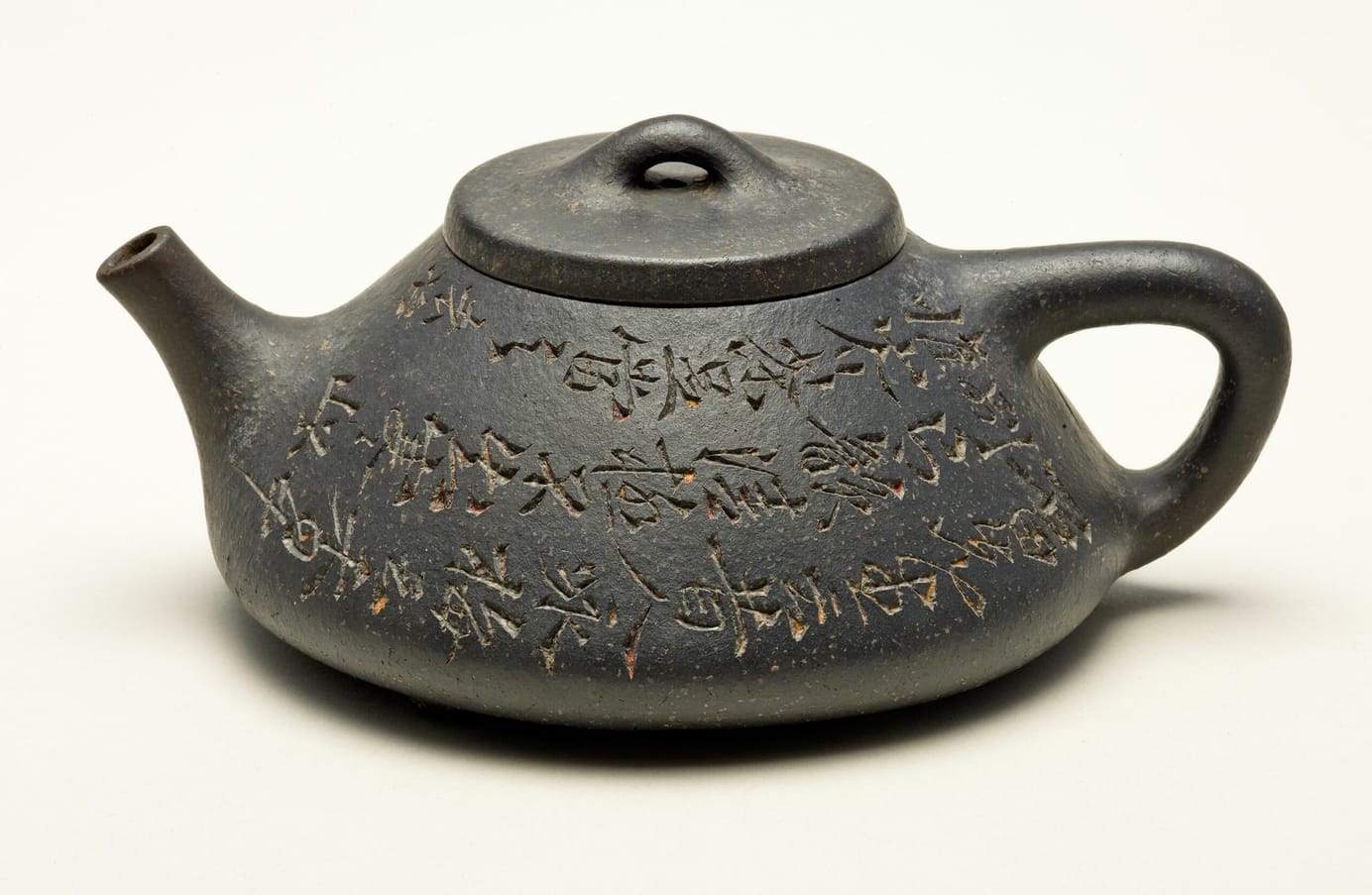
On, on the micro level, on the techniques that are already being done, I think that there's a lot of that. I think the future of Yixing, a lot of the future innovation in Yixing is the revival of prior arts. We saw it a little bit while we were there. We discussed it a little bit and my opinion on this throughout the writing of the book has really shifted where I was a hundred percent on the literati scholar teapot should be absolutely playing no adornments, no crazy shapes, and now, now, I, I love my heart sutra (巨轮珠) julunzhu. I love some of these more interesting painted Yixing wares that, that have an overglaze painting on it. I love the return of contemporary calligraphy and inscription and landscape on Yixing.
Actually, you know what, these really are traditional arts that are being revived and now practiced after being totally, almost entirely halted during the, the F1 and early modern period. And, to have this revival of, of something very similar to what we were seeing in late Qing early ROC with these additive art forms where they're using new, new techniques and new technology to revive older practices. I think that that type of a diffusion and that type of integration and that type of reinvigoration of tradition is truly a magnificent time to be part of the, the Yixing community. And it's totally different than the sculptural Yixing works and artificially dyed Yixing works that we see that has taken over a lot of the industry. I think that this competes with that in a way that is beneficial and hearkens to the great parts of the tradition.
[00:31:20] Pat Penny: So I feel like we have seen over the course of studying the history of Yixing going from pre Ming, Ming into Qing, there is always this element of trying to bolster the art piece by tying it to some previous or older significant cultural item, right? And it's the same with tea. We talked about this at length with Lu Yu writing the Cha Jing and bringing in these disparate threads of the Shennong (神农) and other bits here and there. So I, I do agree with you that whatever kind of the next innovation in teapots is, I'm sure it's going to hark back as well as look forward. I think that's an interesting thing that we always see in, in Chinese culture as we approach innovation.
[00:31:59] Zongjun Li: Yeah, a tea gathering has always been the bowling room, referencing your example previously Jason. But it, it, it really has been the bowling room for literati historically, and the teapot being the center of a tea gathering along with the tea inside the teapot naturally becomes the focus of a gathering. And that's usually the best gateway to lure into the host's artistic taste. So, any kind of design or finish or decorations or anything related to the teapot really reflects on what the current state of mind of the host is. And I think that's great. If it's a plain teapot that does the job, great. If it's a tree trunk that reflects the most recent trendy naturalist designed of, of the art trend, that's great too. And especially when it's finished well. As a Gongchun, that's always a pleasure to look at.
[00:32:56] Jason Cohen: Well everyone, that's all the time that we have for today. Thank you all for joining us in this edition of Tea Technique Editorial Conversations. Please join us again for our next conversation, Reduction Firing Wuhui Black Yixing Wares.

)