Editorial Conversation: Chapter 11, Section 1: Magnetism & Black Coring (黑骨)

The episode is also available on YouTube and Spotify.
A full transcript is included on the episode page and below:
[00:00:05] Jason Cohen: Hello everyone. I'm Jason Cohen, the author of an Introduction to the Art and Science of Chinese Tea Ceremony. Today we're discussing book two, chapter 11, Flaws in Zisha Clay, Magnetism and Black Coring. Here to talk about this chapter is our editorial team, Patrick Penny.
[00:00:20] Pat Penny: Hey. Hey.
[00:00:21] Jason Cohen: And Zongjun Li.
[00:00:23] Zongjun Li: Hello. Hello.
[00:00:24] Jason Cohen: Before we look at any specific flaw, I wanna zoom out and discuss what is a flaw and is there a universal agreement on what constitutes a flaw? Is one man's flawed ware another man's treasure, so to speak?
[00:00:38] Pat Penny: I think as you've allude to in this chapter I don't know that there's a universal definition of what a flaw is. Certainly, we do think that there is one, if something is wrong with the material or it doesn't meet up to a certain standard, you would call it flawed. But I guess as we've looked at Yixing in the past, we've evaluated it from both the clay and ore miner's kind of lens. We've looked at it through the artisan's lens, we've looked at it through collector's lens, and I think, flaws, we look through those different lenses could be different things to those different people, right? And so, us as collectors, maybe more so speaking at myself, just a user of Yixing teapots, there's certain things that are definitely flaws. Worksmanship errors where you don't have, let's say good pouring or flow through the spout, a closed hole on the top of your teapot, not allowing air flow through.
And then as we move specifically into this chapter, maybe we'll get into it a little bit more, we talk about black coring and for some people if you're looking around on Instagram, you certainly are seeing people who are looking for pots that display magnetism. But, as we're pretty aware of, and as you see in this chapter through some of the pictures, teapots that display this magnetism and have black coring, at least without bloating, are particularly brittle. And I personally don't really want to own a teapot where if I put it down slightly wrong, I might crack or fragment it. So, you know, I'd still look at it as a flaw, even if there might be some positive attributes that come along with it.
[00:02:05] Zongjun Li: Yeah, a great excuse to go to a kintsugi artist to get a fix. Some golden seams intertwined with black clay. Yeah, but I certainly agree. Us as user will probably care more about any flaws or defectives that will affect our user experience of a teapot. But, there are many others out there will consider some appearance defective as a flaw too. But as you said Jason, one person's flaw can be other people's treasure. That happens many times in the history too. For example, a very famous aesthetic trend in Chinese celadon being the chipped glaze that was originally a flaw, but later on become a aesthetic.
[00:02:47] Jason Cohen: That's a great example. That's also an example of a material flaw, right? When talking about construction mistakes or when talking about blocked holes or a poor spout that dribbles, those are some types of workmanship flaws or those are just poorly built teapots. But more specifically on material flaws, wouldn't we say that there are some real material flaws? There are under fired teapots, or there's something that, there's a highly muting under fired materials that we sometimes facetiously call shou puer pots, right? So what, what, what constitutes a flaw when it's not negatively impacting the tea? So Pat, you brought up that brittleness is a flaw. Why do some people reject that as a feature that constitutes a flaw, so to speak?
[00:03:35] Pat Penny: Are you saying, why do some people believe that that's not a flaw?
[00:03:39] Jason Cohen: Sure. From a material perspective, what's the argument for or against it being flawed? Right? Obviously a teapot that, that makes your tea taste like mud is flawed. That's a, that's not a usable ware. But from a materials perspective, what's the debate?
[00:03:53] Pat Penny: Yeah, it's a tough debate actually, because I would say anything that makes it more difficult for you to utilize a ware could be a flaw, but then from another perspective, things that might make it more difficult but still produce a good cup of tea could be seen as the gong fu of it, right? You need some level of skill to utilize this ware. And so if a ware that experienced black coring that maybe comes along with magnetism, right? If this ware is producing good tea, but requires you to be very careful and delicate in the handling of it, it's hard to say that's a bad thing, right?
Now if I am, I'm unlikely to use a pot like that willy-nilly 'cause it's probably an antique. But let's say, you know, I want to use it for my my, my Monday, Tuesday, Wednesday night brewing and I'm not paying so much attention, it could be seen as a flaw that I might quite easily chip it if I'm a little bit mindless with it, whereas maybe some other teapots would be able to withstand, let's say, just being put down a little bit without specific care. So it's a debatable point.
[00:04:53] Jason Cohen: But would you make the same argument against something like eggshell cups, which are just as thin, just as fragile, or say, you know, an antique paper thin, flaky glaze. Are these types of things unique to the material, or is this an option of construction?
[00:05:11] Pat Penny: I think partially it's an option of construction for other wares. And it is not an option when something has experienced this firing flaw. I think that's the difference. If I'm seeking out Yixing, I expect it to have a certain impact on my tea. And I do believe that I think of Yixing, particularly after we went to Yixing and saw its use as a very common ware and very much as an everyday ware, I do expect a certain degree of durability from my Yixing. And so, when I'm buying it, I think I have certain parameters in mind. If I was going to buy like a Chuan Xin Diao (穿心銚), right? Like Chaozhou clay, super thin Chuan Xin Diao. I think I would know what I'm getting into. And I, I understand the parameters of its durability, so there's different expectations placed on these different wares. One of these things was supposed to be made that way, whereas the black coring flaw, you won't know it until it's too late, you've chipped it or you've broken the pot.
[00:06:05] Zongjun Li: Ah, I totally agree. For a actual cup, it's thin by design. That's the intention of the designer and it's the expectation of the buyer. Whereas for black coring, it's totally accidental. At least, for all of the real black coring wares. Maybe, with nowadays technology, we can intentionally achieve that outcome. But originally, those are not by design, and I think that's what makes people care so much about it.
[00:06:34] Jason Cohen: That's a great argument. We've been discussing black coring as if everyone has read the chapter before listening to the podcast, which is certainly not the case. Zongjun, can you define black coring for us and can you explain to our listeners what material features make black coring a flaw?
We've stated that it's fragile, that it's paired with magnetism but I don't think anyone's worried that it's gonna magnetize their tea. So what is black coring and what are the features that make it a flaw?
[00:06:59] Zongjun Li: I would just give a very short and layman explanation of this phenomena as if anyone really want to dive in, there's this long chapter with a lot of scientific explanations.
Essentially black coring is a misfired, or not necessarily misfire, but overly reduction fired clay as a result of a either impurity from the original clay or a not very well designed kiln atmosphere or both. And this impurity usually coming from either some organic matter or some sulfurous impurity such as pyrite in the ore reduce the overall sintering temperature of the clay during firing which trigger the clay's performance in high temperature, much more like a glass. And the outcome as people coined a nickname Black Glass is what essentially the matter that constitute black coring.
And it's essentially glass inside your teapot that makes the teapot very brittle in usage. And sometimes, it would even just break even before usage, like after taking out from the kiln partly. Because as the sulfurous content in the clay gets heat up, there is this off-gassing phase, which can sometimes the gas be trapped inside these glass matter which will result in a outcome we call it a bloating. So it's basically a bulb that would surface out from the body of the teapot and will trigger crackage or breakage.
[00:08:38] Jason Cohen: So black coring alone may or may not be a flaw, but black coring is paired with other flaws. Is that right?
[00:08:45] Zongjun Li: Yeah, yeah.
Sometimes you can even have totally fine teapot with a little bit of black coring inside. It's really undetectable before you stick a magnet on top of your teapot.
[00:08:56] Jason Cohen: Or if it chips or breaks, right? Because,
[00:08:58] Zongjun Li: Or if it chips or breaks, you can see the inside. But you know, without that, you will never know. Maybe you own a black coring teapot without knowing.
[00:09:05] Jason Cohen: Let's clarify. Is magnetism alone a sign of black coring?
[00:09:10] Zongjun Li: Not necessarily. Sometimes the, the clay or the teapot can contain the higher amount of FeO without having a black coring inside the teapot, can have magnetism. So it's not a defining factor, but certainly a indication.
[00:09:27] Jason Cohen: Pat, was a flow chart really necessary?
[00:09:30] Pat Penny: The flow chart might be the greatest contribution on black coring to, to the tea community that we've delivered thus far. I think if you try and learn what black coring is right now across all the forums, it is impossible to, I think, to get a very true scientific understanding. The flow chart takes what you can learn in depth in the eight or nine pages, that is the rest of the chapter, which I still recommend reading. But at least I think allows you to have the tools to get through the rest of the chapter and understand everything. So I kept scrolling back up and referring to it as I was reading through the chapter. Great job with it, by the way.
[00:10:04] Jason Cohen: Thank you. Much appreciated.
This chapter starts by citing the magnetic materials and clay wares published by the Royal Society in 1913. It cites the features of Devonian coal bearing deposits in South China, published in the International Journal of Coal Geology. How, my question is how much detail is really necessary for a book on Yixing wares? And how do you as an editor balance the fractal nature of reality with limitations on readability, depth of knowledge, and the focus of the subject at hand?
[00:10:32] Pat Penny: How did I know that the last podcast we record of 2024 we'd be talking about the fractal natures of reality again. Pretty sure again, Yeah.
I think I maybe will not answer the latter question, but answering the former. I, I think it is actually as we've already broken down a lot of lithography and geographical history. We've talked quite a lot about different lenses and deposition through the course of the entire book, but certainly in earlier chapters. I, I think it's important that we revisit a lot of those topics as they pertain specifically to certain portions of the chapter. Just so that we can really ground ourselves. And I think you do it actually to disprove an argument in this chapter, but to ground ourselves in first principles and understand really where the materials are coming from that we believe are through different interactions and processing and then firing having the effects that we're seeing, right? So it's important to know that yes, we are seeing specific coal deposits or specific organic matter deposits, which would result in, in the area of Yixing, right? These flaws that we're seeing. If we don't understand the materials behind why this flaw is happening and we just understand when we see it, I don't think it gives us a full picture.
And so I think this chapter, as I said, is one of the really only places online now that people can really get a full picture of what black coring is in Yixing. As far as balancing the fact checking on the whole, I think I was for maybe for like once or the second time I was like the last person to get back to you on this chapter. And it's because I really wanted to go through the chemistry that you had outlined here. Maybe not specifically the geology but the chemistry I really wanted to make sure made sense and I knew you did your homework, but that's our jobs as editors is to go through with a fine tooth comb and make sure everything goes beyond making sense, but is true.
[00:12:19] Zongjun Li: I think talking about geology and the biology and geography in these topics really makes sense 'cause black coring didn't happen totally by accident. Or out of nowhere. There was a reason behind it. Peated Scotch didn't create out of the blue because there were peat in Scotland and their water flow by those peat areas, which generate a peat flavor water. And people use peat to smoke their malt. And like all of these things happened, it's human anthropology is a result of their surrounding. It's a result of the geology, the geography as a whole. So I think it's necessary to talk about it, but to, to what extent? In what detail? I think it's up to the author's judgment, but it's certainly necessary, I would say.
[00:13:03] Jason Cohen: You, you wouldn't have included the map of coal deposits in this chapter?
[00:13:08] Zongjun Li: I would. I would. I would.
[00:13:11] Pat Penny: Well, no, if I was writing the book, I probably would not have, but that's just because I wouldn't have thought to put it in there.
[00:13:17] Zongjun Li: Next time we can include a sedimentary layer of what kind of minerals deposit or
[00:13:22] Pat Penny: Next time we do a survey, Zongjun, when we go back.
[00:13:25] Jason Cohen: Don't tempt me Zongjun. Don't tempt me.
[00:13:30] Pat Penny: Start applying for the permit now so that we can do a geological survey next time we return.
[00:13:35] Zongjun Li: Yeah, we can we can draw another set of diagrams that detail all of the clay layer formation and the rubbles and all that.
[00:13:42] Jason Cohen: We did actually already do that. We already published it. I linked to it in the chapter. It's in a side note.
[00:13:47] Zongjun Li: Oh.
[00:13:48] Pat Penny: Didn't you, aren't you the one who did the drawing Zongjun, the design?
[00:13:51] Zongjun Li: Yeah.
[00:13:52] Jason Cohen: What's the best counter argument for a listener who hears us say that this is encyclopedic or we don't know how applied this is. We don't know where you're gonna use this information. What's the best counter argument to say to them from your perspective as editors that this is not just encyclopedia at this point, that there's something more to the collation of facts and details within this book that we're publishing?
[00:14:17] Pat Penny: So I, I think the book and the chapters as we move along, they tell a story, right? And so it is telling you through a collection of chapters on history and through the chapters as we talk about geography and how the land around Yixing has transformed over time and how human culture has interacted with it and how that culture has developed this art product that we interact with. It is telling actually a, like a very human story. And so yes, it is quite historical. It's quite scientific and detailed. But through it, I think it gives you quite a multifaceted lens on this ware that we all interact with that, that goes beyond just what is this ware, but tells you who's using this ware, how did this ware develop?
And so I think to really understand the story of Yixing beyond just what the clay is and what pots are, a lot of the additional insight and detail that's added here, I think really is necessary to have the broadest picture you can have of Yixing without maybe having to go to Yixing. So I think in a lot of facets, not to be super gatekeeper, but in a lot of facets of tea, it's very hard to understand tea until you've gone to a tea producing region, until you've seen tea produced by hand or actually done it yourself. It's hard to understand a lot of these wares until you've had the chance to actually try and, as we've done, make Yixing cups or pots by yourself. I think this book is the closest thing that anyone is gonna get to having the experience of going to Yixing and learning with either ore refiners or artisans who are crafting Yixing pots through the level of detail that's in here. I think it's gonna be the closest that anyone gets to that experience. I still recommend doing all those things. This book I think is gonna give you the closest experience to actually having lived Yixing.
[00:16:02] Zongjun Li: And to some extent, it does resemble some characteristic of a encyclopedia.
But you know, on the other hand, this is a encyclopedia solely for zisha, for Yixing. There's a theme that weaved everything together. So it's nothing irrelevant other than anything related to zisha, that's first. And the second is that us as editor and author are clearly writing and revealing this book and researching about the topics coming from our own perspective. So we are not taking our perspective away and trying to be neutral. We are not neutral. We have opinions. We are tea drinkers. We are Yixing teapot users. We have our own opinion and those opinions are imbued and translate into, into this book.
[00:16:52] Pat Penny: I think the next kind of layer of that is we want the people who are in this community whether it's you listen to the podcast, you're subscribed to the book and you're reading the chapters, because our opinions are in here, we do actually want commentary, questions and feedback. And I think we're looking for more of it, right? So this book is supposed to be a living document and a living area of discussion for the Western tea facing community. So, I don't think you can quite do that with an encyclopedia. I guess you could maybe send an email to Encyclopedia Britannica and start chatting with their administrators, but it's probably not quite the same.
[00:17:25] Jason Cohen: Why are black coring Yixing wares collected?
[00:17:28] Pat Penny: I think you do a really good job of breaking this down in this chapter because as my experience at least with black coring wares, it is really just seeing people on Instagram trying to sell and or obtain them. And so, a lot of the information in this chapter is secondhand knowledge for me. I'm learning it through this chapter 'cause I have not used to my knowledge, black core wares.
So I think you, you broke it down really well at the end of the chapter, but many of the wares that display magnetism or many of the wares that do have black coring, identified maybe through some small chips in the pot, were wares that were fired using good clay. They are verifiable antiques. They were fired in a dragon kiln. So wood-fired pots. And so, the black coring in addition to the magnetism is a way to know that you have a verifiable antique with properties that are gonna be good for brewing tea. So, you know, we talked a lot about it being a flaw up top, but if you are getting these wares and you're handling them carefully and the provenance was well explored before you purchase them, they should display quite good characteristics for brewing tea.
[00:18:33] Jason Cohen: Have you ever used a black core Yixing ware?
[00:18:37] Pat Penny: Well, I just said to my knowledge, I don't know, I don't think so.
[00:18:41] Zongjun Li: Not with knowing, not knowingly.
[00:18:45] Jason Cohen: The few times that I have, it's always been excellent. But.
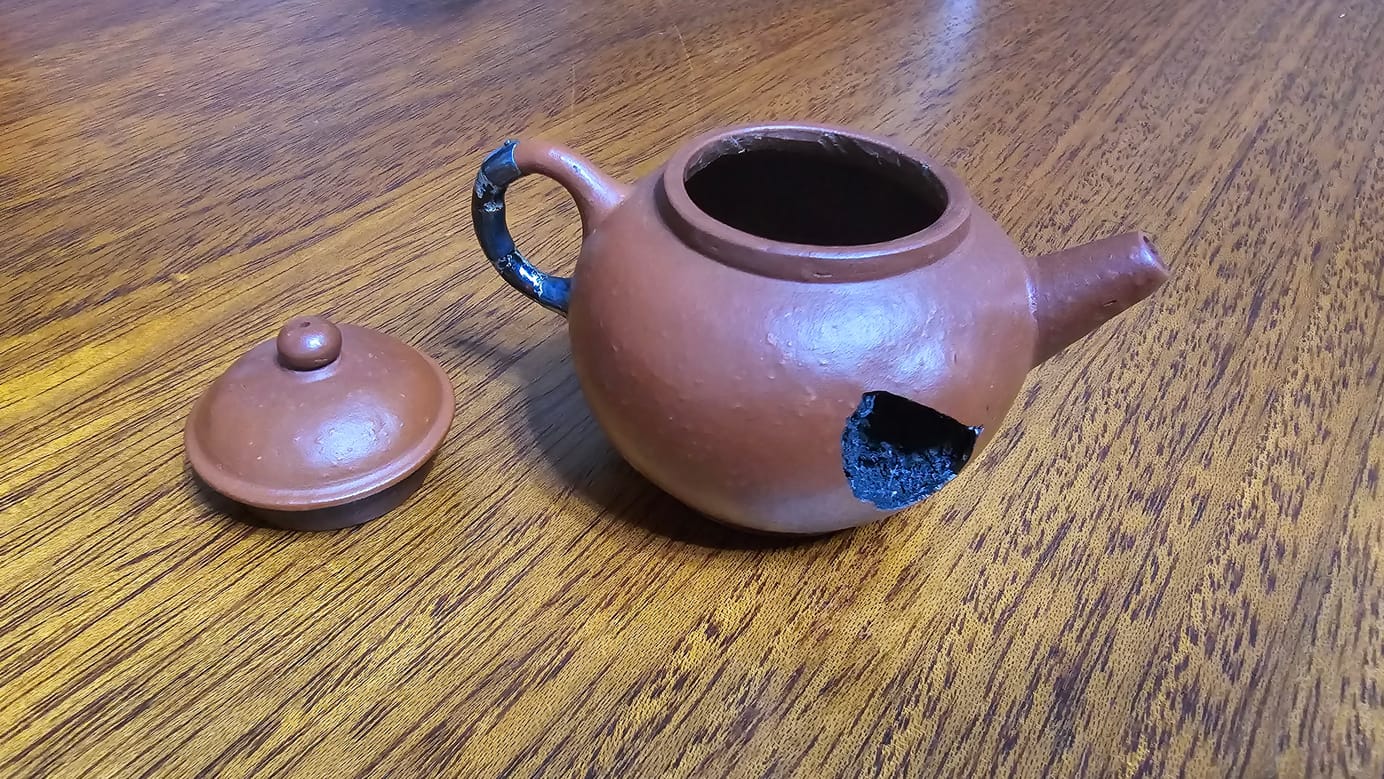
[00:18:49] Pat Penny: Well, the photo included in this chapter is from you. Do you want to talk a little bit more about this photo?
[00:18:55] Jason Cohen: I do. That is a quite an amazing piece. That is a verified Qing dynasty ware. It is black core through and through, and in fact, it actually was black core and bloated such that the, the bloating bubble exploded. Revealing the black core, but the teapot magically stayed in whole form, and I got to experience this with a very well regarded, very famous Yixing teapot collector and scholar, Dr. Lu in Taiwan. Brewing in that teapot, he was kind enough to share with me some very interesting teas including some Taiwanese colonial era teas. And that's one of a couple times that I've had tea out of those teapots, but I find them to be exemplary of what you expect zhuni clay to do. So for things like Taiwanese high mountain oolong, for things like age, but very fragrant, floral Yiwu sheng puer, I find that they have such a concentrating and sharpening effect on the desirable aromatics that are unparalleled amongst other wares and brewing implements. And so I've, I've always been quite impressed and even with that one, which is most obviously flawed, I was astounded at its effect. And how notable its effect is.
[00:20:23] Zongjun Li: Flawing appearance then, it's didn't affect the usage.
[00:20:26] Jason Cohen: Yeah, well, it does have a little bubble on the inside. You couldn't do like Chaozhou gong fu. You couldn't pack that teapot.
[00:20:32] Pat Penny: But Jason, the real question is how many black core teapots are you searching for to add to your collection?
[00:20:38] Jason Cohen: How many am I hoarding? I will acquire at least one. And it will be studied alongside the others for information that's gonna go into the publishing the rest of this book. But, turns out, Qing Dynasty zhuni wares are expensive. So
[00:20:52] Pat Penny: We need more subscribers is what you're saying?
[00:20:55] Jason Cohen: Yes, please. And subscribe and you know where your support is going.
But really, you know, I don't think anyone has done a material analysis, a textural analysis, of porosity analysis of the skin of a black core Yixing ware, particularly not in comparison to other antique zhuni. And I think that type of analysis would be very revealing over what it is specifically about those wares that draw collectors to them beyond being identifiable. I think to your point, Pat, that black coring as an identifying attribute in helping place a teapot in time can't be overlooked, right? People love imperial wares with mark and period because they can point at it and they say, I know exactly when this is from. And that, that's quite difficult to do with most Yixing wares.
[00:21:44] Pat Penny: You talked to the characteristics, the positive characteristics that black core wares display. And we were just discussing that none of that analysis has been done. What do you hypothesize that the causal factor for why these wares are having such a positive effect that you described is?
[00:22:03] Jason Cohen: My causal factor is that it's going to be the same attributes as other Qing dynasty, non-black core zhuni. I don't believe that the surface texture is changed by black coring. It's an interior flaw. And if you're using amazing clay fired in a dragon kiln from Qing Dynasty zhuni, you're gonna get great results. So, so I don't think that there's anything different about black core antique zhuni from non-black core antique zhuni.
[00:22:36] Zongjun Li: But would you say that the vitrification level might be slightly higher than non-black core zhuni because of the eutectic effect?
[00:22:47] Jason Cohen: It'd be the other way. The black core is because it's glassy on the inside. It's more
[00:22:52] Zongjun Li: It's more vitified.
[00:22:53] Jason Cohen: Yeah, it's more vitrified. But in, in my theory of tea interaction, as you both know, I currently do not support the porosity thesis for interactions. I don't believe that Yixing teapots are absorbing and giving out tea.
[00:23:08] Zongjun Li: But the surface texture might be more vitrified too.
[00:23:11] Jason Cohen: Why should it be though if the surface texture is still red, it's still zhuni colored.
[00:23:15] Zongjun Li: That is true. That is true.
[00:23:17] Pat Penny: I would think that there would be some thermal properties that are changed though by having basically the entire interior between the surfaces on both sides being basically glass, right? Totally vitrified. I would wonder what that heat transmission effect is like.
[00:23:30] Jason Cohen: That's true, densification and thus a higher thermal mass.
[00:23:34] Zongjun Li: So from the photo that you shared in the chapter, it looks like it's really just the skin, like the very surface of the teapot remained the zhuni texture and zhuni color.
[00:23:46] Jason Cohen: Yes.
[00:23:47] Zongjun Li: Everything through is black core. So
[00:23:51] Jason Cohen: Yes.
[00:23:51] Pat Penny: That one is black.
[00:23:54] Jason Cohen: That one is a quite extreme example.
[00:23:58] Zongjun Li: Yeah, pretty interesting.
[00:24:01] Jason Cohen: But I think that's why this is so interesting, right? Because it's another way of testing whether or not our theory of interaction is correct, that it's a surface level interaction based on the texture of the material, unique textural properties. And that's why wood-fired wares have a larger effect. And that's why dragon kiln's longer firing had a larger effect. And we go on and on for all these things, but it's not so much that we can't make teapots as good today as we could back then using similar methodologies like stone milling, long aging periods. It's that particularly in dragon kiln firings, this long firing process resulted in unique textural attributes.
[00:24:42] Pat Penny: We got deep there.
[00:24:43] Jason Cohen: My last question, would you collect a black core Yixing ware, both ignoring price and not ignoring price. Taking price into consideration.
[00:24:54] Pat Penny: Ignoring price. Yes. Not ignoring price. I'd have to have a really good year. Do I want basically antique zhuni ware? Yes.
I would prefer to have an antique zhuni that is non-black court, if possible. Although harder to verify, but certainly when I think about the durability and being a cat owner and many other factors, I'd prefer to have something that still has a decent durability, even though I will still be treating it either way as delicately as possible. I just worry about even, warming up the pot.
[00:25:28] Jason Cohen: Zongjun, would you buy a non-black core antique zhuni or would you buy a black core antique zhuni?
[00:25:33] Zongjun Li: Well, with the budget, both.
[00:25:36] Jason Cohen: Side by side.
[00:25:37] Zongjun Li: Yeah, side by side comparison.
[00:25:40] Jason Cohen: There's no price on an education.
[00:25:43] Zongjun Li: Life experience.
[00:25:46] Jason Cohen: Well, thank you everyone for joining us in this edition of Tea Technique Editorial Conversations.
Please join us again for our next conversation, more Flaws in Zisha clay.

)