Editorial Conversation: Chapter 11, Section 2 & 3: Tie Rong (铁熔) and Tu Hei (吐黑)

The episode is also available on YouTube and Spotify.
A full transcript is included on the episode page and below:
[00:00:05] Jason Cohen: Hello, everyone. I'm Jason Cohen, the author of An Introduction to the Art and Science of Chinese Tea Ceremony. Today, we're discussing Book 2, Chapter 11, Flaws in Zisha Clay, Tie Rong (铁熔) and Tu Hei (吐黑). Here to talk about those chapters, our editorial team, Patrick Penny.
[00:00:19] Pat Penny: Hey, hey.
[00:00:21] Jason Cohen: And Zongjun Li.
[00:00:22] Zongjun Li: Hello, hello.
[00:00:23] Jason Cohen: Hello, everyone.
We're discussing two flaws today: tie rong, iron spotting, and tuhei, black vomiting. Before we begin, a question for the editors. The later of these sections, tuhei, has a rather technical explanation that debunks the standard explanation in both English and Chinese literature. How do you as an editor balance the need for technical accuracy, historical relevance, and the accessibility of these discussions?
[00:00:48] Zongjun Li: Well, tuhei is a especially tricky one because if you actually know how to read Chinese, is particularly misleading. The very term tuhei implies that something is getting oozed out from inside. So the name itself is misleading to begin with, and for a lot of the literatures in Chinese and English would tend to explain that it's all of these micro channels that exist within zisha clay that led to some organic matter being oozed out or transport or penetrated out from the tea inside of the teapot to the tea surface outside and then it gets oxidized, and then it turns black.
That's the explanation for a lot of the authors and quite honestly I think this is the theory behind the invention of this name tuhei. But in fact we know that for such micro channel to exist for a lot of teapots it's just not possible. Unless it's like grossly under fired or a grossly under processed clay, sandy, grainy clay for such thing to happen.
[00:01:56] Pat Penny: Yeah, I think Jason referring to like how we go through this material and vet truth from hypothesis from the propagated mythology that exists across other reading materials and various languages. It is kind of tough. We've talked, I think, on other podcasts about how we go about proofreading.
And I think in the case of this where in the absence of other materials available to us in either language to help cite the case for tuhei of the hypothesis that you've generated, you really just have to return back to first principles and try to understand what is it that's being said about tuhei and how it comes to be, and what do we know to be true from our discussions with potters and from our understanding of the fired clay.
And when you look at the existing theory to date, it's pretty easy from a first principle standpoint to disprove it. I think we will have the opportunity as well, Jason, unless you've already done this, to work with our potter friends to see examples of this as well and prove out the thesis that we've put forward.
[00:02:59] Jason Cohen: Continuing on that line of thought, when you receive a chapter like this and you see something that contradicts or attempts to correct, hopefully correctly correct the standard interpretation of what's going on, the standard set of, I'll put it in air quotes, "facts" that is propagated in part of the mythology and part of prior technical explanations that, that may be misled how do you go about deriving things from first principles?
I mean, my assessment is you would read the chapter, you see something, you Google tuhei or whatever it is, and you say, "Oh, okay, well, this differs exceedingly from the explanations that everyone else is giving." Right? What is your immediate reaction there? I'm sure readers go through this. What is your reaction when going through this as an editor?
[00:03:50] Zongjun Li: Well, for tuhei in particular, also for a lot of these mystified claims throughout the history that we have been seeing online or in different literatures, sometimes the parts that will raise a question mark doesn't necessarily comes from the thing that you are trying to investigate. Like for example, for tuhei, like people claim that okay, it's some microchannel that exists within the clay. And then they start claiming that the water molecule is smaller than the water vapor molecule. That's why sometimes water can penetrate through the clay and carry some organic matter through. Then you start to question, okay, so people who claim such thing also believe this, that in a cascading effect, you should start questioning other claims that exist in those articles. So that's usually, how I start being more critical throughout my research journey of doing editing.
[00:04:46] Pat Penny: Yeah, I think I, I take a very general stance to it, and when I read e- either a claim that you make that's contradictory to the existing narrative or even when it's in agreement with the existing narrative, I try and just always start with what if the opposite is actually true? What does that look like, or how do I try and make a counterfactual argument? And if that counterfactual becomes, if I start having to really stretch to make that seem realistic then I have to go back and go, "Well, okay, may- maybe this narrative is onto something." And then I'll try and apply my knowledge as a scientist and try and understand from a chemistry mechanism, particularly for this book, right, that's been helpful, if the narrative that you've laid out is the most sensible one or logical one.
In the previous book, I couldn't exactly use my scientific background as much to try and prove out some of these hypotheses, but it's still similar. I would usually try and apply a counterfactual, and then from there follow the logic a- as best as possible. There's a lot of Google searching involved.
[00:05:48] Jason Cohen: What is tie rong, and what constitutes the boundary between acceptable and flawed levels of iron spotting on zisha ware?
[00:05:56] Pat Penny: Tie rong is, a- as you said, iron spotting. So e- everyone who's held a zisha pot of some sort has probably seen this before. It shows up as a black speck on your teapot. It can be of varying size. There can be varying quantity. And determining whether it's a flaw or not a flaw, some of that might come down to a subjective analysis. But for me, I think a small spot here or there on the teapot, particularly darker colored teapots, really doesn't mean anything to me. I think if you start to see a high concentration of spots to the point where it obscures the natural color of the clay or even changes the feel of the clay as I'm trying to examine the quality of a teapot or the feel of a teapot over the surface, if the tie rong is getting in the way all the time, then for me, I'm like, "Okay, there's probably too much tie rong going on in this pot." But yeah, I w- I would say anything that's kind of obscuring the visual a- appeal of the clay itself.
It's one of those flaws that I don't actually know what the impact to the tea is, and I don't really believe there's much of an impact. So it, it feels like more of a flaw for somebody who appreciates Yixing more as an art form and less as a tool. Where have you guys seen it actually interrupt your brewing practice in any way?
[00:07:14] Zongjun Li: Well, if it's along the rim and it impacts how the lid's sealing the teapot, then I would consider that being a flaw. Or if they exist in large quantity inside the teapot, then it might directly interact with the tea brewing inside. But other than that, if it's not causing any leakage of water, I wouldn't necessarily say it's a very significant flaw.
[00:07:38] Jason Cohen: Do you have any difference in opinion on the level of tie rong that constitutes a flaw, Zongjun, or do you agree with Pat?
[00:07:47] Zongjun Li: Yeah, I largely agree. If it's not really impacting the appearance, like ... but the, the line is very, it's very vague, like-
[00:07:57] Jason Cohen: Well, what, let me, let me give you a counter example. What about the zhima (芝麻) sesame class of duanni (缎泥) and luni (绿泥) wares?
[00:08:04] Zongjun Li: Yeah. That's particularly tricky, 'cause how do you tell a tie rong apart from the zhima inclusions that could be other clays? So, that's, that's exceptionally tricky.
[00:08:16] Pat Penny: Yeah. It feels like a particularly subjective flaw. I think Zongjun made a good point. Other than where it might interrupt the actual function of the teapot, which I think there's very few locations it could do that, it really does feel like a, I think you've stated in this chapter, it's a visual flaw, right? And when we're evaluating Yixing from an artistic perspective, sure, the tie rong is a flaw particularly if there's a lot or large ones. But from a usage perspective, it's... I think all of my teapots have tie rong on them. I can't think of a single one. I haven't gone over them with a fine-tooth comb, but I think all of them have tie rong and I don't feel any differently about them because of it.
[00:08:53] Jason Cohen: It's a particularly visual flaw, right? 'Cause as Zongjun said, it's not forming on the inside of the teapot. It's a predominantly a surface flaw. Perhaps we would have very different opinions about tie rong if it was coating the inside of a teapot and was interacting with the tea in some way.
[00:09:08] Zongjun Li: Yeah. That would be problematic. And also the implication of tie rong exist in, on a teapot might, might raise some other question mark. 'Cause tie rong, if it's really ugly and you can still see it on a teapot that's on shelf, it's probably not a very high quality teapot to begin with. It's not a very hard flaw to be correct during firing. During zhengkou (整口) frequently you can see artists just taking out the tie rong part and then refill it with some those makeup clay, hua zhuang ni (化妆泥) and then the teapot gets refired and then the tie rong part won't exist.
[00:09:44] Jason Cohen: There's not too many of them, right? They only do those repairs if it's worth repairing. If a teapot comes out totally speckled then of course.
[00:09:52] Zongjun Li: Then the raw clay definitely haven't gone through a magnetic sieve for many times.
[00:09:59] Pat Penny: Yeah. That's what I was gonna say is to your point, Zongjun, I think on older pots, I notice it a little bit more. But on my modern pots, certainly those have all gone through magnetic sieve and I, yeah I don't feel like I've seen it too much on any of my modern pots.
[00:10:13] Jason Cohen: So continuing on that line, how has the prevalence of tie rong formations changed over time?
[00:10:18] Zongjun Li: Well, tie rong was more rare in very old teapot when teapot still were fired in dragon kiln like during Ming dynasty and early Qing. And then it start to become more popular during the introduction of all of the down-draft kilns and new firing technology and new firing fuel which introduced a lot of the impurity into the teapot and causing tie rong to happen.
And then, you have new technology getting invented which is magnetic sieve that we were talking about that can really sift out all of the iron impurity from the raw clay. And ever since that machine has invented you see a drastic decline of tie rong exist in teapot as a flaw.
[00:11:02] Jason Cohen: How should a practitioner assess wares with iron spots? At what level of iron spotting should they be wary of purchasing the ware?
[00:11:11] Pat Penny: They should approach it like a microbiological count, so most probable number. They look in a one-inch square and they count the number they see, and then you can multiply that, right? No.
But I don't know. I think if you have the chance to handle a ware, it is probably subjective as we've discussed to this point. If you feel like you're seeing a lot of tie rong, then it's probably too much. If you are looking at the teapot and you're not really noticing it jump out at you, you see one here or there, then it's probably fine. I think the presence of tie rong is not a problem. I think if you are paying attention and you do notice it, then it's probably already too much.
[00:11:49] Jason Cohen: So if it's ugly, don't buy it, and if there's more on the inside than the outside, don't buy it, is the advice.
[00:11:55] Pat Penny: I think that's pretty clear, yeah.
[00:11:57] Jason Cohen: Do you have any wares in your collection, either of you, with excessive iron spots?
[00:12:01] Pat Penny: I have one zini (紫泥) teapot with excessive iron spots, and there are some on the inside too. And that was one I bought that online, so was not able to look at it up close before receiving it.
[00:12:12] Jason Cohen: Western tea culture has done you wrong.
[00:12:14] Pat Penny: It was a western-facing vendor. That's correct.
[00:12:17] Zongjun Li: Oh, no. Yeah, I have a sesame duanni teapot and with my naked eye I won't be able to tell the sesames from the tie rongs. But with some microscopic analysis we might be able to do that in the future.
[00:12:31] Jason Cohen: We, we have. Just with a magnifying glass would be enough. But you and I have the same teapot. This is the Baiyue Duan, is that right?
[00:12:37] Zongjun Li: Yeah. Yeah.
[00:12:38] Jason Cohen: Yeah. I do enjoy that teapot, though I think it is excessive tie rong. Would either of you purchase an antique with excessive tie rong?
[00:12:47] Pat Penny: If it's not on the inside, yeah.
[00:12:50] Zongjun Li: Yeah. Sometimes the tie rong, it's underneath the surface and it looks like a bruise or, or like a mold. And I think that's particularly ugly.
[00:12:59] Jason Cohen: That's considered part of the flaw when multiple of them fuse together under the surface.
[00:13:04] Zongjun Li: Yeah. But if it's like a localized protrusion on the surface and it's tiny, then it's probably fine.
[00:13:10] Pat Penny: That's what bothers me about my zini. So it's on the inside and there's a few spots where I've looked at it multiple times and particularly prior to knowing about tie rong, not from this chapter, but when I first realized it was iron, was not immediate in my tea journey. So the first couple times I was looking at it, I was like, "Is that mold? Did my teapot mold?" And eventually I realized that it's iron spots, but yeah, that, I think that was concerning to me.
[00:13:36] Jason Cohen: What do you say to someone who thinks that tie rong is elemental iron and can rust?
[00:13:41] Pat Penny: Leave water in your pot and then let it dry out and see what happens. I mean, that's another first principle, so you can try it yourself.
[00:13:49] Zongjun Li: Yeah. Agree.
[00:13:50] Pat Penny: Try it at home.
[00:13:51] Jason Cohen: I always thought the simpler one was that elemental iron isn't black.
[00:13:55] Pat Penny: I mean, you write as much in the book, but if it's written, these people probably, if they believe that, then they probably don't believe everything that they read, so let them test it themselves.
[00:14:06] Jason Cohen: Moving on to our second flaw under discussion today, what is tuhei (吐黑) and how does tuhei form?
[00:14:11] Zongjun Li: Well, as we were talking about before, the Chinese definition for tuhei literally means vomiting or spitting black. So you know, the wares with tuhei tend to look pretty dirty and dark outside. And classic or traditional theory goes by saying that it's the tea that carry a lot of the organic mechanisms oozing out from the inside of the teapot to the outside through a bunch of micro channels and then the organic matter oxidize over time.
And for, for us, for our research, obviously we don't believe that such micro channels exist in, in most of the teapots. And the very reason for such oxidation to happened is because underfired teapot have exceptionally rough surface texture that traps a lot of these organic matter leaking out from the teapot. When you brew tea, sometimes you fill the teapot and then certainly some tea water is going to come out and cover the surface. And over time, those organic matter gets trapped on the surface of the teapot and it oxidized and it turn black. So it's basically a cha shan (茶山) that's forming outside instead of the inside. Yeah.
[00:15:24] Pat Penny: Yeah, and I think this is something that's seen with teapots that are underfired and so you have particularly porous outside as well. You have complexes that different polyphenols in the tea are able to make with organic compounds in this underfired zisha teapot.
And, Jason, I think that something that's really cool that you write about here is the way that we're kind of able to prove this thesis is that you could fire this pot again, right? And that organic matter would actually be disintegrated, fired off and combust. And you could go back to having a totally normal looking teapot. It would no longer have the black vomiting. So, I think it's just a better way to understand how this mechanism is happening with the tea material collecting on the surface of the teapot.
[00:16:08] Jason Cohen: Do all subtypes of zisha clay suffer from tuhei equivalently?
[00:16:13] Pat Penny: I think the lighter the pot, the more it's gonna show up. So for me, it's things like duanni or luni would be the worst offenders. If your baiyue duan was underfired, I mean, it would look particularly heinous on that.
[00:16:26] Jason Cohen: Some of the flaws that we've discussed, including tie rong, I classify as partial flaws, as there's differences in opinions or levels of assessment on what is acceptable for the prevalence of such a feature. Is there any argument to be made for tuhei as a partial flaw, or is tuhei always a complete flaw?
[00:16:49] Pat Penny: I think tie rong is a little more clear-cut in where it's definitely a flaw and where it's up to your subjective interpretation. Tuhei I feel like is a really blurred one. I definitely feel like if it's excessive then it's certainly a flaw. I do view it, I think, a little more that in general, if it's under fired enough for tuhei to happen, it's probably a total issue with the teapot and a more complete flaw than something like tie rong is.
[00:17:14] Zongjun Li: Yeah. I think the problem is on under firing, not on tuhei. Tuhei is just a phenomenon of such a, such thing. So if the under fire level is not necessarily impacting the performance of the teapot, then it's probably okay. But if it's really under fired and start seeing leakage in the actual micro channels, then it's problematic.
[00:17:36] Pat Penny: Ma- macro channels.
[00:17:38] Zongjun Li: Macro, macro channels.
[00:17:40] Pat Penny: I mean, it really comes down to this. Do you want another shou pot? I don't think so.
[00:17:44] Jason Cohen: Are all under fired wares at risk of developing tuhei?
[00:17:50] Pat Penny: I think it really depends on the degree of how under fired it is, right? So if you've had enough sintering that this organic matter is not able to rest within the surface of the teapot then y- you won't see tuhei, but if it's so under fired that the organic matter can really embed itself in the teapot then you're certainly gonna see it. But I, I think it depends on that range of firing.
[00:18:11] Zongjun Li: Yeah. Also depends on the clay type. Some clays have more mica content and it tends to be more vitrified. So if it's still under fired, but it's more vitrified, then the surface is glossy enough for these organic matter to be trapped.
[00:18:25] Jason Cohen: Why do you think the simpler iron ion deposition explanation has persisted in the literature, in both English and Chinese, without correction? Everyone else has the same access to knowledge as we do. We're not spending outrageous sums of money on this specific test. Why hasn't this been corrected?
[00:18:44] Zongjun Li: You're referring to tuhei or tie rong, Jason?
[00:18:49] Jason Cohen: Tuhei. Tuhei.
[00:18:50] Zongjun Li: Well, for Chinese, I would say there are a lot of these probably mental inertia and also, the name itself has a really strong implication of the classic theory that something is coming out from inside. So, it doesn't necessarily triggered a lot of critical thinking, I would say, for this matter.
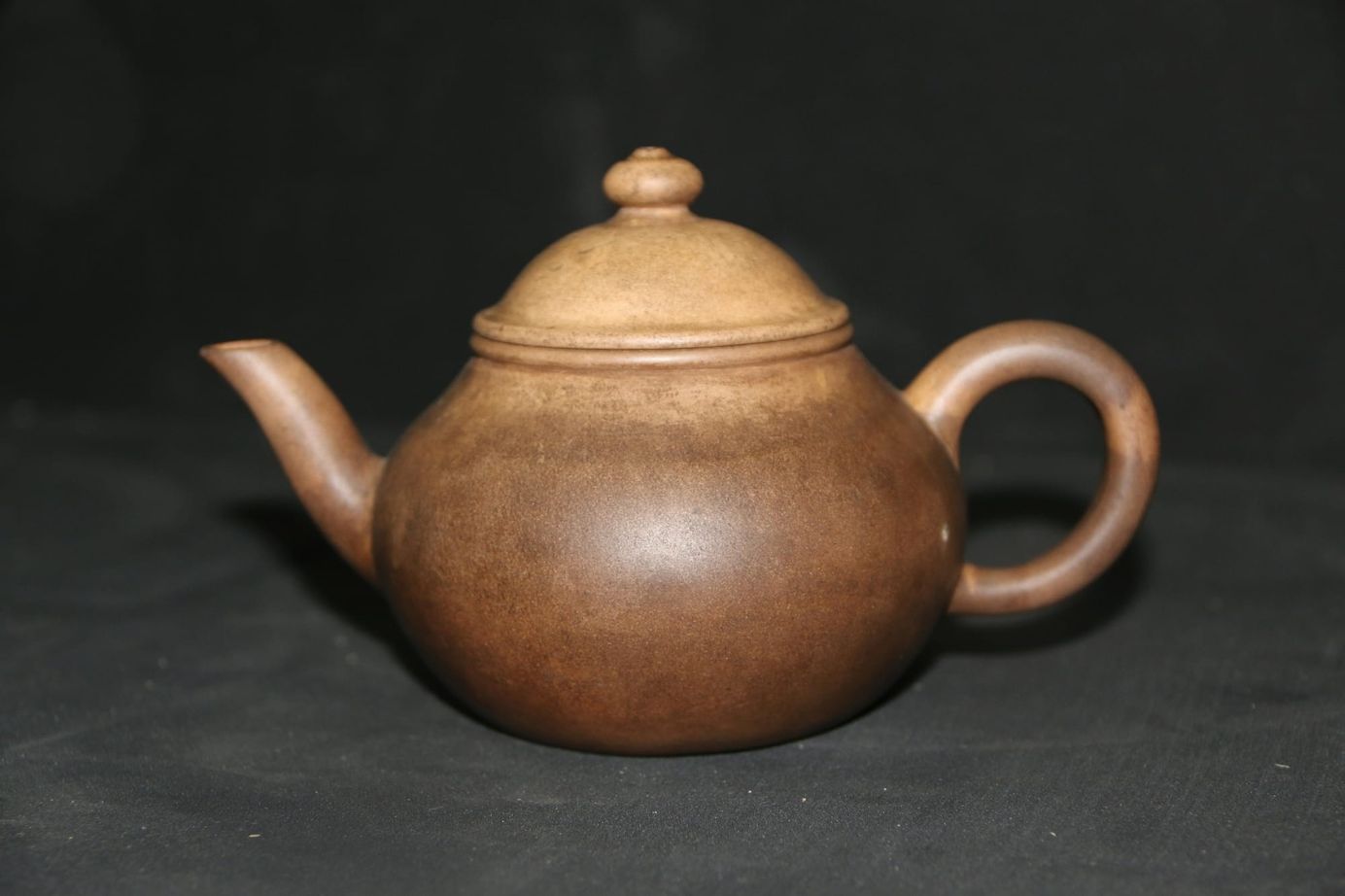
[00:19:10] Pat Penny: Certainly that's a possible explanation. I think this is also a particularly obscure sub flaw within Yixing, and it's possible that there's just not a lot of people who have even never seen a pot that has tuhei, let alone thought when they saw it. I mean, in the chapter, the first teapot that you show as an example, a teapot by Wu Dacheng, it really has such a slight amount of this flaw that I don't think if I saw that teapot, prior to reading thoroughly through this chapter, I don't think I would've thought that anything was going on with it. I would've thought it's a little discoloration, maybe the clay was unevenly fired or something. I don't know. I think it's probably something that just a lot of people don't think about or haven't particularly researched into and so the existing definitions have not been challenged.
[00:19:56] Jason Cohen: You wouldn't have gone into Sotheby's auction and said, "That's a dirty teapot"?
[00:20:00] Pat Penny: I mean that's literally what I might have thought before learning about tuhei. I might have just thought "Oh, wow, someone really built up a patina on that. That could use a little bit of a soaking." Like that- ... that honestly might've been what I would've thought.
[00:20:11] Zongjun Li: That's history you're washing now.
[00:20:13] Pat Penny: Think about it. If you look online at old teapot forums, so many people are cleaning Yixing teapots with like slight oxidizing agents and things like that to get rid of these patinas and I might have thought of tuhei as just a patina in a lot of cases.
[00:20:27] Zongjun Li: Not to mention that a lot of these teapot grandpa in China will... they actually love patinas, so.
[00:20:34] Pat Penny: Tuhei's a positive thing to them.
[00:20:35] Zongjun Li: Yeah, it's a positive thing to them.
[00:20:37] Jason Cohen: Cha, cha shan.
Cha shan is a positive thing to them. I don't know about tuhei.
[00:20:41] Pat Penny: They might not know the difference though, right?
They're just developing a quicker cha shan. This teapot develops such a quick patina, it's amazing.
[00:20:47] Zongjun Li: It's amazing and also because I use exceptionally good tea.
[00:20:51] Jason Cohen: On that note, how important is it to understand the precise chemical mechanism when evaluating Yixing wares, either for these flaws or for any of the other topics that we've had under discussion?
[00:21:01] Pat Penny: I think that's a question that, that almost goes back to your kinda first question around balancing truth and everything as an editor, right? As a reader, how much of this is important for you to completely digest and take away and know as you're going to buy a teapot? I don't know that you need to completely understand every mechanism laid out in this book.
I think it's important to try and walk through the logic yourself and see where it makes sense or doesn't make sense to you and try to research more where you want to. I don't think you have to fully understand to know that the flaw exists and to try and understand how to make sure that you're not, if you don't like this flaw, which I would say for tuhei, you should not like tuhei. Tie rong may be subjective. Kn- know why it's happening, maybe not step by step, but the general mechanism and what to avoid as a collector or a purchaser.
[00:21:53] Zongjun Li: Yeah. Or just know the existence of such thing, 'cause the trick of turning bugs into features exists widely in the world of teapot. And for tie rong for example you will see sometimes some merchants will claim that tie rong is good and it implies higher iron content, and-
[00:22:10] Jason Cohen: Proves that it's real.
[00:22:11] Zongjun Li: Yeah the water hard and it's good for your tea and tastes sweeter. You see a- all these kind of merchant marketing and if you know that's tie rong, it's nothing special.
[00:22:20] Jason Cohen: This is actually zhima zhuni.
[00:22:22] Pat Penny: And like we were saying for tuhei, it could easily just be like this is an antique. What are you talking about? This is an antique. Over time it's built up this patina, when in fact it's just an underfired teapot that was used a few times.
[00:22:33] Jason Cohen: The new Z- ZMZN. Everyone heard it here first. Zhima zhuni.
[00:22:41] Zongjun Li: Oh. I thought you were trying to say something Chinese.
[00:22:44] Jason Cohen: Okay. Continuing on that same thought again, how can a practitioner or collector tell the difference between a well-developed patina, say, on a antique ware and tuhei? If you're bidding at auction, for example, Sotheby's isn't gonna allow you to clean the teapot with your oxidizing cleanser before bidding.
[00:23:03] Pat Penny: I would say in my experience at least, tuhei versus a good patina, as in still a clean teapot, but maybe one that's older and hasn't been used for a long time, patina is usually more even. Tuhei to me from what I've seen at least has always shown up as kind of a gradient, and so you can see areas where it was lighter and areas where the coloration is heavier. And I think that's probably showing as a gradient in the level of completion of firing and sintering that you're seeing in the pot as well. So I think it would just be that roughness or unevenness of the coloration that I'd be looking out for as a sign that something has a flaw.
[00:23:38] Zongjun Li: If it does indeed give you a kind of a dirty vibe, then it's definitely more leaning towards the tuhei side.
[00:23:46] Pat Penny: That pot is dirty.
[00:23:48] Zongjun Li: Dirty. Dank.
[00:23:50] Jason Cohen: Is tuhei fixable?
[00:23:53] Zongjun Li: Yeah. A common fix that you tend to see people do is to give the tuhei teapot a light refire, usually around 1,000 degree Celsius. And it would just burn off all of the organic matter on the teapot. But you know, it does ... The fix is still risky. It's like all of the refiring process, crackage is a problem that you need to take account into.
[00:24:19] Jason Cohen: I don't know if I would call that method common, but would you attempt the huiyao (回窑) method on an antique teapot suffering from tuhei?
[00:24:27] Zongjun Li: Oh, for antique, probably not. For my personal teapot, maybe. But I would ask for a refund first.
[00:24:34] Pat Penny: Yeah. I think the antique teapot whether or not it has a flaw, it's an antique for a reason, and hopefully you've negotiated the right price based on that flaw. But probably never worth the refire.
[00:24:46] Jason Cohen: Believe it or not, I have had tea from a huiyao treated teapot. The flaw was a little bit different than tuhei but there's another flaw that can be treated with that treatment. And I had tea out of it. It survived the refiring. The tea was great. A- and so that leads me to the question, does the restoration of a flawed piece suffering from tie rong or suffering from tuhei or suffering from some other flaw and running it through firing again, how does that affect its authenticity or its value?
[00:25:22] Pat Penny: Yeah it's a really good question. So, at some level, once you've done huiyao, it does make me think of some of the experiments that we've been doing with single fire versus double fire teapots. And so these antiques would've gone through a single, probably dragon kiln firing. They have particular properties.
In the case of one suffering from tuhei, it was underfired, and so I think that huiyao, in my opinion while I might... I wouldn't do it with an antique I bought because I think I wouldn't want to risk the product, right? But in my opinion, it does not change the provenance of that pot and hopefully would make it more usable.
It, it is a, it's a tough discussion though, because you are changing the pore structure of the pot. You are changing the pot in a way that goes beyond just that look that was impacted by tuhei. You're now changing how it's likely gonna perform with tea. So, I don't know. That's a tough one.
[00:26:13] Jason Cohen: The open and closed pore structure, the amorphous silicate melt, the formation of new crystals, certainly.
[00:26:21] Zongjun Li: Yeah. It might even change the color too. But it really comes down to how are you going to use this teapot in the future? If it's going to be indeed your daily personal teapot and you want to use it very extensively for various good tea for your tea collection, then you probably should try to make it more usable.
But, if it's just part of your collection, for me, I would probably not do it, 'cause this is a... For me, it's actually a pretty good example of, such a thing exist throughout the history. And you can find-
[00:26:53] Jason Cohen: There's, there is no teapot that is just part of my collection. They're each unique and special in their own way.
[00:26:59] Pat Penny: I really like Zongjun saying if this antique is your daily teapot, whew, you're a baller if you're just using some antique as your daily brewing pot.
[00:27:06] Jason Cohen: Well, I was gonna say it depends on how many teapots, how many antique teapots you have, whether or not you-
[00:27:10] Pat Penny: No, that's true. I guess if you just have one, then...
[00:27:13] Jason Cohen: The huiyao... I am personally not purchasing anything and doing huiyao. I'll let someone else take the risk.
[00:27:21] Pat Penny: Yeah, agreed. Agreed on that. I think it is a really good question that you raised though, because when we look at pieces in museums that have been restored, the purpose of that is so that people can still enjoy that art form, whatever it is, painting, ceramic ware. But you're enjoying it from a visual perspective.
For a teapot, when you're restoring it, you are indelibly changing something about it and it will no longer perform in the same way it did before. And so if it did perform positively, but just had a visual flaw I, I probably would not risk that restoration of the pot. I would find that to be a degradation if the properties are positive. But you know, yeah I'll buy someone else's huiyao.
[00:28:00] Jason Cohen: Well, everyone, that's all the time that we have for today. Thank you for joining us in this edition of Tea Technique Editorial Conversations. Please join us again for our next conversation, More Flaws in Zisha Clay.


%20and%20Tu%20Hei%20(%E5%90%90%E9%BB%91))